
Monero began as BitMonero on April 18, 2014, using code forked from Bytecoin and privacy techniques described by CryptoNote. The pseudonymous developer thankful_for_today launched it with a new blockchain. A community-backed team soon took over development. The launch announcement and Monero’s account of the handover document those separate steps.
The mystery lies further back: who wrote CryptoNote, when its earliest papers circulated, and how Bytecoin’s early supply was distributed. Some claims have contemporary public records behind them. Others rest on disputed accounts.
Who was Nicolas van Saberhagen?
Nicolas van Saberhagen is the name attached to the CryptoNote white paper. A verified real-world identity is not established by the sources reviewed here. WIRED’s 2017 reporting also describes the author as pseudonymous.
The CryptoNote v2 white paper bears the name Nicolas van Saberhagen and the date October 17, 2013. Its starting complaint is easy to understand. Bitcoin lets people transact without putting their legal names on the blockchain, but its public transaction history gives observers a way to follow money. CryptoNote proposed a different transaction design. You can read the paper alongside early reviewers’ comments in Monero’s annotated copy.
It is also unclear whether the name represents one person or several. A name on a paper is attribution, not proof of a civil identity. Our guide to verifying a PGP signature covers a related question: whether a file was signed by a key you trust.
The date also needs checking. A printed date records what a document claims. To establish when that version first circulated, we need records from outside the document. That became a central issue in the arguments about CryptoNote’s history.
What is CryptoNote, and how did Monero use it?
CryptoNote is a cryptocurrency protocol designed to obscure links between payments and their participants. Bytecoin implemented it, and Monero began from Bytecoin’s code. CryptoNote, Bytecoin (BCN), and Monero (XMR) therefore refer to a protocol and two distinct currencies. The implementation lineage is recorded in MRL-0002.
Two ideas explain much of its appeal. Ring signatures let a spender authorize a payment among a group of possible signing keys without identifying which one supplied the signature. One-time destination keys let a recipient publish an address without making every incoming payment visibly point to that same address. These are core elements of the CryptoNote proposal.
The design addresses two questions: which earlier output was spent, and who received the new output? CryptoNote tried to obscure both connections. Its early implementation still left clues that analysts could use, as the research discussed below shows.
An outside academic comparison by Christopher D. Clack and Nicolas T. Courtois examines CryptoNote’s use of ring signatures and key derivation alongside another privacy design, Möbius. Their 2019 paper provides a separate technical account of those mechanisms. It does not establish who wrote CryptoNote or settle Bytecoin’s launch history.
Blockchain privacy is only one part of using a wallet privately. Our I2P vs Tor comparison explains network privacy, while our Monero remote-node guide explains what a node operator can learn from a wallet connection.
Why is Bytecoin’s early history disputed?
Bytecoin, ticker BCN, brought CryptoNote into a working currency before Monero. Its Bitcointalk announcement thread dates from March 12, 2014. The opening post, which was edited afterward, claims the currency began on July 4, 2012.
Those are different kinds of dates. One belongs to a surviving public forum record. The other is a claim about an earlier launch. A forum announcement in 2014 does not, by itself, disprove private activity in 2012. It also does not establish that the earlier mining opportunity was widely accessible.
An August 2014 investigation by the forum account rethink-your-strategy challenged that history. It cited PDF metadata, document references, archived websites, and code publication dates. It also reported that a little over 80% of Bytecoin’s eventual emission had already been mined when it attracted attention in 2014. The post is a contemporary accusation with supporting material, not an independent verdict on every person and event it discusses.
The familiar “82% premine” shorthand describes the controversy over a large existing supply and who could mine it. The community-authored book Mastering Monero, section 1.3.4 also reports approximately 82% already emitted. That is corroboration within Monero literature, not an independent audit. This article does not recalculate the percentage or establish who controlled every early coin.
The same investigation alleged backdating of the white papers. File metadata can raise serious questions, but a later PDF build date alone does not prove that no earlier manuscript existed. The disputed chronology should remain visible rather than being quietly converted into a settled date.
When did Monero launch, and did it inherit Bytecoin’s coins?
On April 9, 2014, the forum user thankful_for_today announced a new currency based on the Bytecoin/CryptoNote codebase. The BitMonero announcement gave an April 18 launch date and explicitly said the new coin would start from its own genesis block.
That is the distinction in Monero’s ancestry. Developers reused code, but started a new ledger. Bytecoin balances were not carried into the new currency. Owning BCN did not automatically give someone coins on the BitMonero chain.
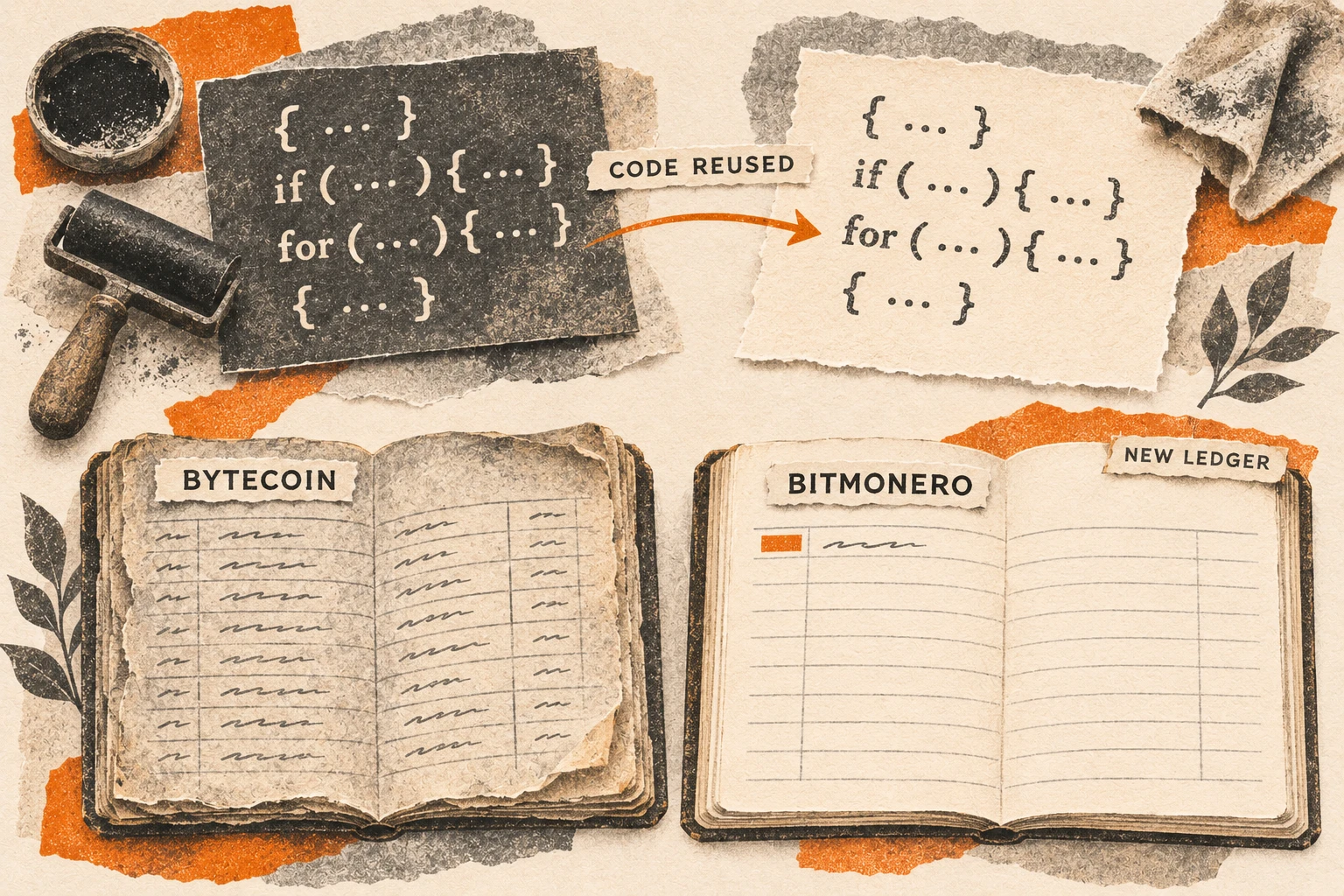
The founder described technical and marketing changes and expressed respect for Bytecoin’s existing community. The announcement complicates later accounts that portray the launch only as a rejection of Bytecoin.
For precision about the code, a September 2014 Monero Research Lab report states that Monero forked Bytecoin’s code before the separate CryptoNote reference code was released. “Based on CryptoNote” describes the protocol lineage. “Forked from Bytecoin” describes where the implementation came from.
Why did BitMonero become Monero?
The project did not remain under thankful_for_today’s direction. Monero’s official history describes a disagreement over proposed changes, followed by a community-backed team taking over development. It describes the launch as pre-announced, without a premine or instamine. The project roadmap records the change from BitMonero to Monero in April 2014.
WIRED’s account of the project’s origins independently reports the disagreement and subsequent community fork. Monero’s own 2014 year-in-review, published in January 2015, places the handover around the end of April and identifies April 30 as thankful_for_today’s last commit.
This was a change in who maintained and directed the project. It should not be confused with the earlier decision to start a new blockchain instead of inheriting Bytecoin’s ledger.
CryptoNote supplied the ideas. Bytecoin supplied the initial code ancestry. Thankful_for_today launched BitMonero. A broader community continued it as Monero. Those were distinct roles, not the work of one identified founder.
CryptoNote to Monero: a sourced timeline
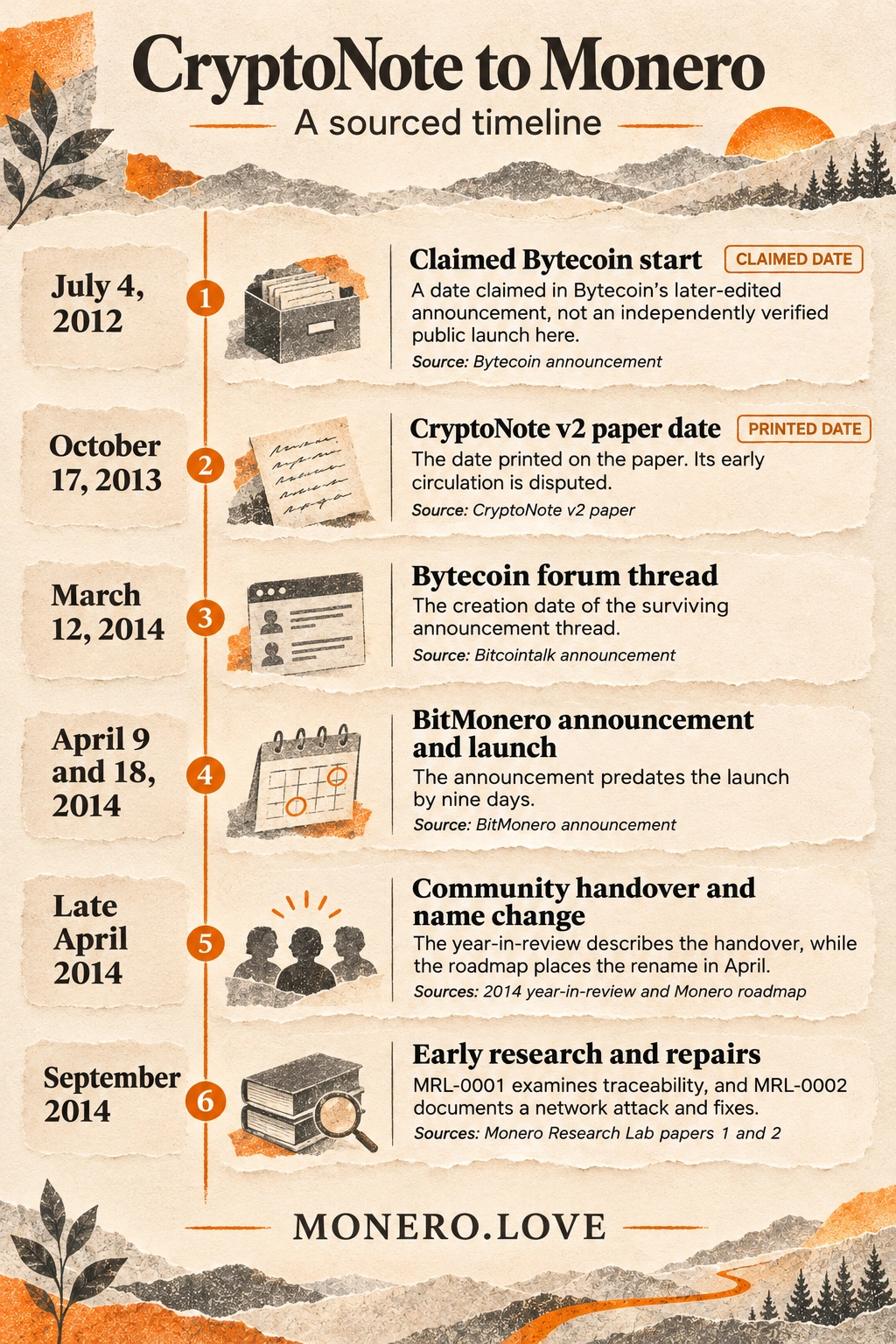
Timeline sources: Bytecoin announcement, CryptoNote v2 paper, BitMonero announcement, 2014 year-in-review, Monero roadmap, MRL-0001, and MRL-0002.
How did Monero improve on early CryptoNote?
In September 2014, Monero Research Lab published MRL-0001, examining how information exposed by one spend could help trace another. If an observer can rule out decoys, fewer possible senders remain. The paper explored how those deductions could spread under particular conditions.
Another report, MRL-0002, documented a September 4 attack exploiting an implementation error in the way blocks’ transaction data were hashed together. It described a network split and the fixes. Inheriting cryptographic ideas also meant inheriting code that needed scrutiny.
Outside researchers later tested historical Monero transactions. Malte Möser and coauthors’ empirical study, first submitted in 2017 and revised in 2018, found weaknesses involving elimination of decoys and differences between the ages of real inputs and decoys. Its results concern the historical transactions and selection methods studied. They should not be presented as measurements of today’s Monero network.
Later changes moved Monero further from its starting point. The historical roadmap records mandatory minimum ring sizes in 2016, RingCT activation in January 2017, and mandatory RingCT transactions in September 2017. RingCT added concealed transaction amounts, as explained in the project’s technical overview. Those later protections should not be projected backward onto every transaction from 2014.
What remains unknown about CryptoNote’s origins?
Nicolas van Saberhagen’s identity, the earliest circulation dates of the papers, and the ownership of Bytecoin’s early supply remain unresolved in the evidence reviewed here. Repeating a claim does not resolve those gaps.
The April 2014 launch and the work that followed have a firmer public record. Monero began with borrowed code and a new ledger. Its contributors then changed the leadership, investigated weaknesses, and revised the software. That documented work explains how CryptoNote became part of Monero’s history, even without a settled account of its authorship.
How this history was checked
This article compares original forum records and Monero’s own research with WIRED’s reporting and papers by outside researchers. The forum records establish what participants posted, including later edits. The academic papers examine technical properties, not the identities of the founders. Monero publications provide firsthand project accounts but are not independent of the community. Where those sources leave a claim unresolved, the article says so.