
You have Bitcoin. Someone else has Monero. You want to trade, but neither of you wants to send first. Fair enough. “Trust me, bro” is a terrible payment system.
Usually, an exchange handles that problem. You deposit your coins, trade inside its system, and hope your withdrawal goes through when you want it to.
An atomic swap offers another way: trade directly with someone on another blockchain, using cryptographic rules to tie the two sides together. There’s no exchange holding both people’s money while it updates a spreadsheet. Monero’s community announced working Bitcoin–Monero atomic swaps in 2021. Monero announcement.
What does “atomic” mean?
Here, atomic means the trade is designed as an all-or-nothing operation. The other person shouldn’t be able to collect your coins and simply refuse to release theirs, provided you follow the protocol’s requirements.
It doesn’t mean instant. Transactions still need confirmations, and a failed swap can involve waiting and recovery steps. The software and its deadlines matter.
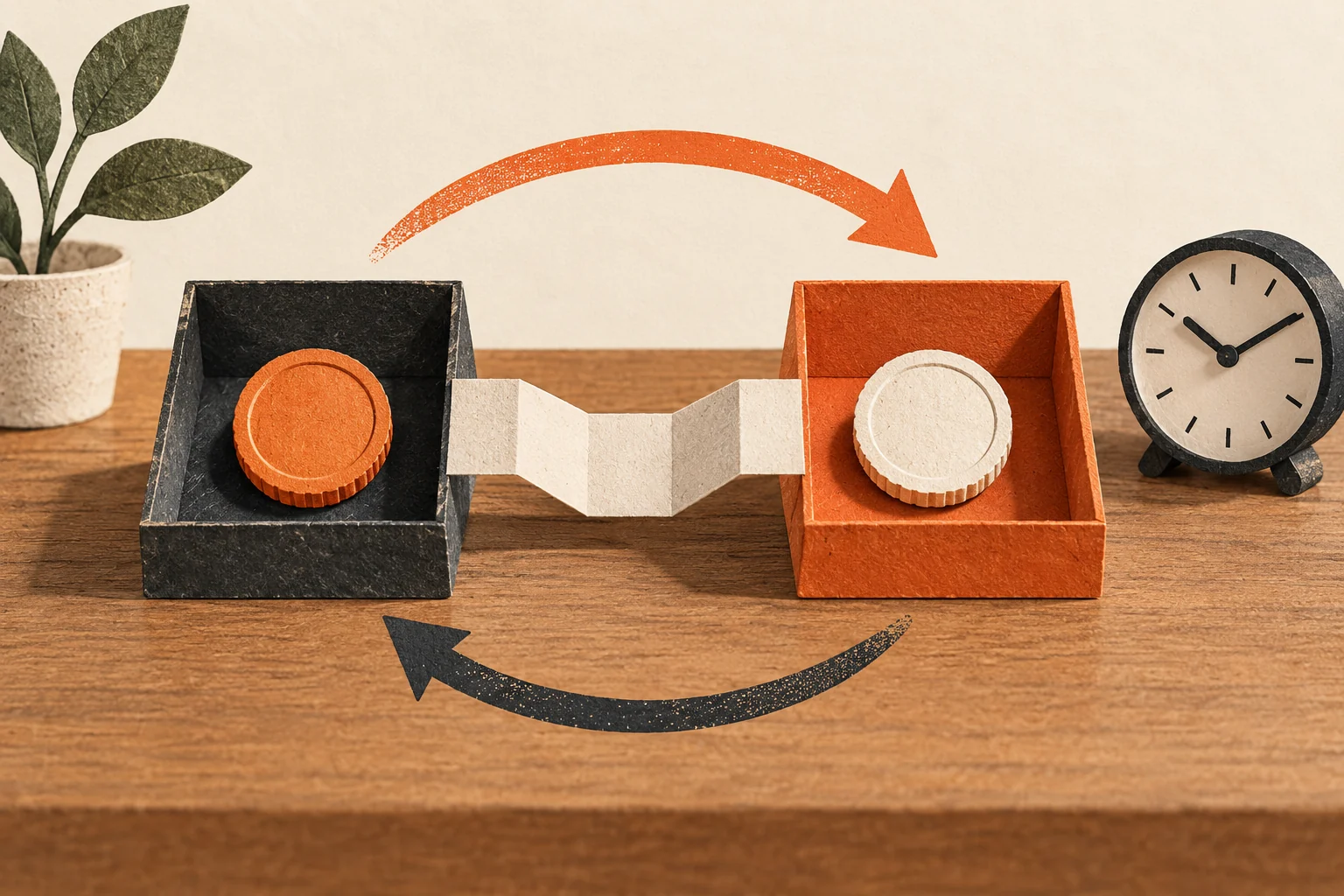
Think of two locked boxes connected by a mechanism. Taking what’s in one box gives the other person what they need to open the second. The locks are cryptography; the boxes are just an analogy.
How do atomic swaps work?
Let’s stick with Bitcoin for Monero. In a working implementation such as eigenwallet, the basic sequence looks like this:
- You pick an offer from someone supplying Monero. You check the rate, amount, and fees before agreeing.
- Your software locks the Bitcoin under the swap’s conditions.
- The other person’s software locks the Monero.
- When they collect the Bitcoin, that action reveals information your software needs to collect the Monero.
You aren’t manually solving puzzles or messaging secret codes to a stranger. The application handles those steps. The coins also stay on their own blockchains: Bitcoin doesn’t turn into Monero. Ownership changes on both sides. Eigenwallet’s walkthrough.
And if the other person disappears?
Swap protocols include recovery paths involving time locks: conditions that become available after enough time or blocks have passed.
But don’t read that as “close the app and everything will sort itself out.” Eigenwallet documents a limited refund window. Missing it can cost you your Bitcoin. Some offers also include an anti-spam deposit that the other party can withhold in certain circumstances. Read the current rules before funding a swap, and keep the app available to finish or recover it. Refund rules.
This is where the word “trustless” gets oversold. You’re reducing your reliance on a stranger’s honesty. You still need working software, a secure device, and the ability to follow the recovery process.
How do Bitcoin–Monero atomic swaps work?
Not exactly. You’ll often see explanations involving a secret and a timed contract called an HTLC. Those describe a common swap design, but Monero doesn’t support the same scripting features as Bitcoin.
Bitcoin–Monero swaps use other techniques, including adaptor signatures. For a beginner, the useful part is that claiming one payment exposes information needed to claim the other. You don’t need to learn the mathematics to understand the trade. Bitcoin–Monero research paper.
What should you check first?
Look at the actual amount you’ll receive, including network fees and the provider’s markup. Check minimums, refund conditions, and which direction the software supports. A website calling something a “swap” doesn’t establish that it’s atomic or that you retain control of your funds.
And keep your privacy expectations sensible. A peer-to-peer protocol can operate without asking for your passport, but it doesn’t erase Bitcoin’s public transaction history or information you already gave an exchange during KYC checks.
Start small enough that a mistake won’t ruin your week. Learn how to recover a failed trade before you need to.
BasicSwap deserves a look
BasicSwap makes this useful. You can find someone to trade with without opening an exchange account or handing over custody of your coins. Its order book is decentralized, and there are no platform trading fees. Network fees still apply.
Next article, we’ll get hands-on with BasicSwap: setting it up, finding an offer, and walking through a swap without assuming you already know the buttons.