Security / Privacy
Qubes OS Security Flaws Could Break Virtual Machine Isolation
Qubes OS QSB-121 covers Xen flaws that let a malicious guest access other virtual machines and dom0. Check affected systems, patches and reboot steps.
Security / Qubes OS / Xen
QSB-125 covers three Xen stale-memory flaws affecting Qubes OS on Intel. Learn which guests are exposed, how the fixes work and how to update safely.

Qubes OS has warned that three newly disclosed Xen vulnerabilities can let a compromised virtual machine keep using memory after Xen has reassigned it. On an affected system, that stale access could expose another qube's data, corrupt privileged memory or crash the host.
Qubes Security Bulletin QSB-125 covers CVE-2026-119781, CVE-2026-119782 and CVE-2026-119783, all tracked upstream as Xen Security Advisory XSA-535. The Xen Project released the advisory at 16:14 UTC on November 26, 2026. Qubes published its bulletin on November 27.
The risk is serious because Xen provides the boundary on which Qubes compartmentalization depends. The disclosure does not show that every Qubes computer has been compromised. The attacker must first control code in a suitable guest, reach one of the affected memory-management paths and turn a short-lived stale mapping into useful access.
Xen is a Type-1 hypervisor. It runs directly above the hardware and below the operating-system domains, assigning CPU time and memory while enforcing which machine pages each guest may access. On x86 HVM and PVH guests, hardware-assisted paging, called HAP, lets the processor walk a second level of translation maintained by Xen.
Qubes builds several kinds of compartments on this foundation. AppVMs run applications and keep their own user data while borrowing system files from a TemplateVM. Templates provide software to the qubes based on them. DisposableVMs start from a known state and discard their changes. Service qubes isolate functions such as networking, firewalls and USB devices. Qubes-Whonix places its Gateway and Workstation roles in separate qubes, but both still depend on the same Xen boundary.
Dom0 is different. It is the administrative domain that manages the system and normally hosts the trusted desktop and Qubes management stack. It has broad authority over other qubes and should not be used for ordinary applications.
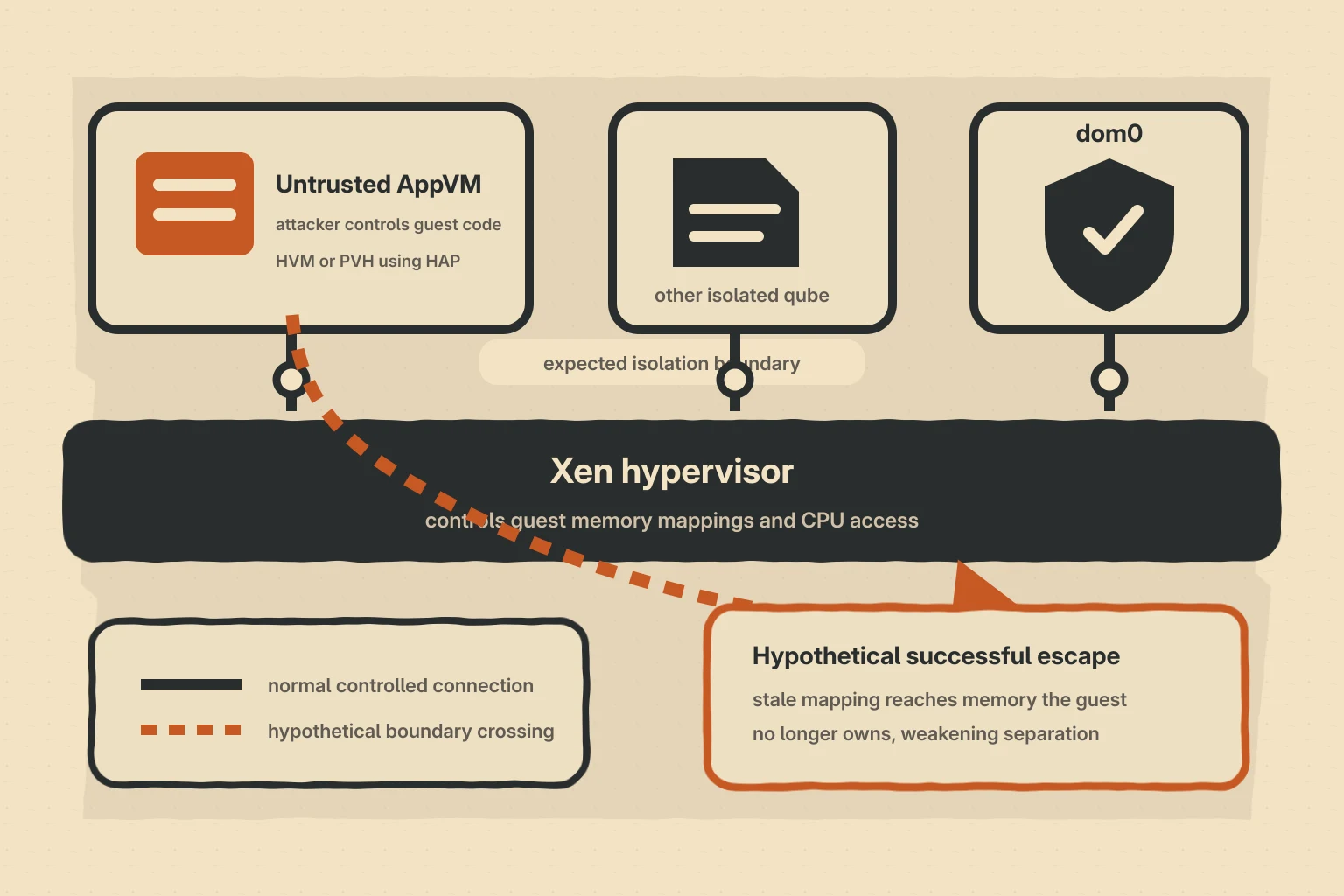
An application flaw inside an AppVM normally leaves Xen's memory boundary intact. A hypervisor flaw is below that boundary. If a guest can make Xen keep a translation to a page that no longer belongs to it, the guest may access memory assigned to another qube or a privileged component. That creates a possible path toward dom0, but it does not make dom0 access automatic.
All three bugs share an ordering failure. Xen changes a guest-physical-to-machine mapping in its p2m table, then defers the related translation lookaside buffer flush until it releases the p2m lock. Batching flushes is an optimization. The bug appears when Xen drops the final reference to the old page before the deferred flush. Xen can then reuse the page while the guest CPU still has a stale translation to it.
The individual CVEs reach that state through different code paths.
CVE-2026-119781 affects guest_remove_page(). In the vulnerable code, Xen called put_page() before put_gfn(). A guest using the decrease-reservation memory operation could cause the page's final reference to be released before put_gfn() unlocked the p2m and performed the pending flush. The fix moves the final page release after the GFN release. The public upstream commit is 6019959aecb1. A malicious or compromised guest kernel can invoke the relevant memory hypercall for its own pages. Ordinary unprivileged application code would first need to gain the guest privileges needed to control that path.
CVE-2026-119782 affects xenmem_add_to_physmap_one(). This path moves or adds a page in a translated guest's physical map while the p2m is already locked. It called guest_remove_page() without separately holding the displaced page. The fix takes an extra page reference, unshares the destination entry before acquiring it and drops the reference only after the p2m lock has been released. It also adds an assertion about lock state. The public commit is a644c78e9740. Xen's target permission model permits a guest to operate on its own translated physical map, so a malicious HVM or PVH guest kernel can reach the self-targeted case without dom0 privileges.
CVE-2026-119783 affects p2m_add_foreign(). This is the foreign-page mapping variant used when a domain maps a page from another domain. The same missing extra reference allowed an overwritten destination page to be freed before the flush. Commit 768deeb73eb9 holds that page until after unlock and flush. This path has separate authorization checks. The caller needs Xen Security Module permission to map the foreign domain's memory, a capability normally associated with control domains or tightly scoped device-model relationships rather than an ordinary AppVM. The foreign path has a stricter prerequisite than the self-memory paths in the first two CVEs.
In each case, useful exploitation also requires the freed page to be reused before the stale translation disappears. Reading a page after it has been assigned elsewhere could disclose information. Writing it could corrupt another domain or privileged state, potentially escalating privilege. Corrupting critical memory can also produce a host-wide denial of service.
XSA-535 says Xen 4.7 and later are affected on Intel x86 processors. AMD x86 processors are affected only with Xen 4.22 and later. Arm is not affected. Only HVM and PVH guests using HAP can trigger the vulnerable behavior. Classic PV guests are outside the advisory's stated scope.
Qubes 4.3 packages Xen 4.19.6. QSB-125 identifies supported Qubes systems on Intel as affected and Qubes systems on AMD as unaffected by this advisory. The difference is not contradictory. Upstream Xen 4.22 added AMD-side deferred-flush behavior that is not present in Qubes 4.3's older Xen branch.
Qubes 4.2 reached end of life on June 21, 2026. QSB-125 lists a fixed package only for supported Qubes 4.3. Anyone still using 4.2 should not assume that the absence of a listed 4.2 package proves safety. The supported course is to upgrade to Qubes 4.3.
Qubes says a compromised PVH or HVM qube can attempt to use the flaw to compromise other qubes, including dom0. This describes architectural risk. The bulletin does not report a working end-to-end escape.
The attacker needs control inside a compatible guest, generally enough control to issue or shape Xen memory operations. They then need to trigger a vulnerable page-removal path and influence page reuse before Xen flushes the stale CPU translation. Turning that access into dom0 code execution would require the stale mapping to cover useful privileged memory and a reliable way to alter it.
Neither XSA-535 nor QSB-125 includes a proof of concept, reports demonstrated guest-to-host code execution or confirms exploitation in the wild. Xen notes that a third party published an incomplete fix while the security team was working. That public patch is evidence that the underlying issue had been discussed, not evidence of a successful exploit.
The complete upstream fix set reorders the generic page release and adds temporary references in the two locked mapping paths. Applying only the foreign-mapping change is insufficient. Xen warns about the earlier incomplete fix for that reason.
QSB-125 names Xen 4.19.6-6 as the fixed Qubes 4.3 package revision. At a repository check completed at 20:43 UTC on November 27, official metadata offered 4.19.6-6.fc41 in both security-testing and its broader parent, current-testing. The stable current repository still offered 4.19.6-5.fc41 as its newest Xen build. This finding comes from active repository metadata, not the presence of a package file on the server.
Qubes signs its security bulletin. Its update design downloads packages in the UpdateVM, then verifies and installs them in dom0. The QSB-125 signatures from Marek Marczykowski-Górecki and Simon Gaiser validated against the keys in the signed Qubes security pack snapshot. This review confirmed publication of the testing RPM and its metadata, but did not independently check that RPM's signature with rpmkeys outside Qubes.
Run these checks in a dom0 terminal. They identify the Qubes release and CPU vendor, then report both installed and running Xen versions. The final command checks available dom0 updates.
cat /etc/qubes-release
lscpu | grep '^Vendor ID:'
rpm -q xen-hypervisor
xl info | grep -E '^(xen_version|xen_extra)'
sudo qubes-dom0-update --check-only
The normal supported route is the Qubes Update tool, with dom0 selected, or this documented command-line route:
sudo qubes-dom0-update
Updating an AppVM, TemplateVM or Whonix template does not replace the host hypervisor. Xen is installed in dom0's package environment and loaded before the qubes start.
As long as 4.19.6-6 remains outside stable, users who stay on the default channel must wait for migration. QSB-125 also documents the option for advanced users who accept testing risk to enable the security-testing repository for one update:
sudo qubes-dom0-update --enablerepo=qubes-dom0-security-testing
Qubes disables security-testing by default because packages have had less community testing. Do not enable it permanently without understanding that tradeoff. Xen states that there is no known temporary mitigation for XSA-535.
After installing the fixed Xen packages, save work and reboot the entire computer. Restarting one qube is not enough because the old hypervisor remains in memory until the host boots again. Then repeat rpm -q xen-hypervisor and the xl info check. The package query should report revision 6 or later, while xl info confirms the running Xen version.
Anti Evil Maid users must follow QSB-125's specific instruction. Updating Xen changes PCR18 and PCR19, so users must reseal the secret passphrase to the new measurements. Use the Anti Evil Maid README for the installed configuration rather than applying generic trusted-boot commands.
Stable-channel migration had not occurred by the 20:43 UTC cutoff. Repository state can change after that time, so users should rely on what the Qubes Update tool offers and confirm the installed revision.
The advisories do not describe exploit reliability, a successful dom0 takeover or observed attacks. They establish that stale guest access can cross a memory-ownership boundary and that privilege escalation, disclosure and host-wide denial of service are possible consequences. They do not establish that every secret on an affected computer is exposed.
Recent Qubes bulletins cover different boundaries. QSB-121 and XSA-523 concerned Xen Grant Copy checks and arbitrary cross-domain reads and writes. QSB-123 covered AMD IOMMU and transient-execution issues. QSB-124 concerned split-gpg2 command filtering above the hypervisor. Only QSB-121 shares the broad theme of Xen-mediated memory isolation, but its mechanism is different. For a wider explanation of the operating systems and compartments, see the Qubes, Tails and Whonix overview.
For affected Intel systems, the practical risk remains until the fixed Xen build is installed and running after a reboot. The disclosed capability warrants prompt remediation, while the lack of a published demonstration or confirmed attacks should keep claims about real-world compromise precise.