Monero Signal / Markets / Mining
Monero Signal: XMR Selling Meets Thinner Bid Liquidity
XMR fell as Kraken's displayed bids thinned and reported liquidations skewed long. Dated market and P2Pool measurements separate observations from causes.
Monero Signal · Price, mining power, and the stories behind the moves.

XMR fell 7.51% against the dollar over 24 hours on Kraken, while the exchange's displayed buy orders near the market were smaller than in this morning's snapshot. Bids within 1% of the midpoint totaled about $319,000, down from $417,000. The sell side grew slightly. That establishes thinner displayed bids at Kraken. The seller identities and market-wide conditions remain unknown.
This Monero Signal edition closes its source collection at 15:45 UTC on November 10, 2026. Price comparisons end at 15:00 UTC, the last completed hourly candle. We captured the order book and mining estimates around 15:39 UTC. Later prices and orders will differ.
Market snapshot
| Kraken pair | Price at 15:00 UTC | 24h change | 7d change | 30d change |
|---|---|---|---|---|
| XMR/USD | $555.39 | -7.51% | -10.69% | +4.20% |
| XMR/BTC | 0.007493 BTC | -7.01% | -7.02% | +16.68% |
All changes compare completed hourly closes at the same UTC hour. The 30-day baseline comes from Kraken candles saved for the earlier edition, because the public API's rolling history no longer reaches that hour. The calculation uses observed closes throughout, with no interpolation. See Kraken XMR/USD candles, XMR/BTC candles and the API's history limits.
Bitcoin's dollar price fell 0.65% over the same 24-hour interval, to $74,313.50 on Kraken. XMR's much larger decline against both currencies means a falling Bitcoin price alone cannot explain its relative performance. It does not identify who sold or why. Bitcoin comparison candles.
Kraken recorded 8,819 XMR of XMR/USD trading in the 24 completed hours, about 94% more than in the preceding, nonoverlapping 24-hour window. That measures trading at one venue. CoinMarketCap separately displayed $141.53 million in combined rolling 24-hour volume when retrieved at 15:40:58 UTC. Different venue coverage, units and cutoffs make those figures unsuitable for direct comparison. CoinMarketCap's Monero page.
Fewer displayed bids, not fewer orders on both sides
The earlier edition preserved an order book around 01:47 UTC. Applying the same calculation to the 15:39 snapshot gives this comparison:
| Kraken XMR/USD book | Around 01:47 UTC | Around 15:39 UTC |
|---|---|---|
| Bid/ask spread, as % of midpoint | 0.149% | 0.204% |
| Bids within 1% below midpoint | $417,021 | $318,826 |
| Asks within 1% above midpoint | $558,016 | $575,369 |
Displayed bid value fell 23.55%, while ask value rose 3.11%. Each band extends 1% from its own snapshot's midpoint. The comparison uses equal relative-price bands whose absolute price levels differ. Some of the dollar-value change also reflects the lower XMR price. The book contained enough levels to reach beyond both bands. Kraken depth response, compared with the saved record for this morning's edition.
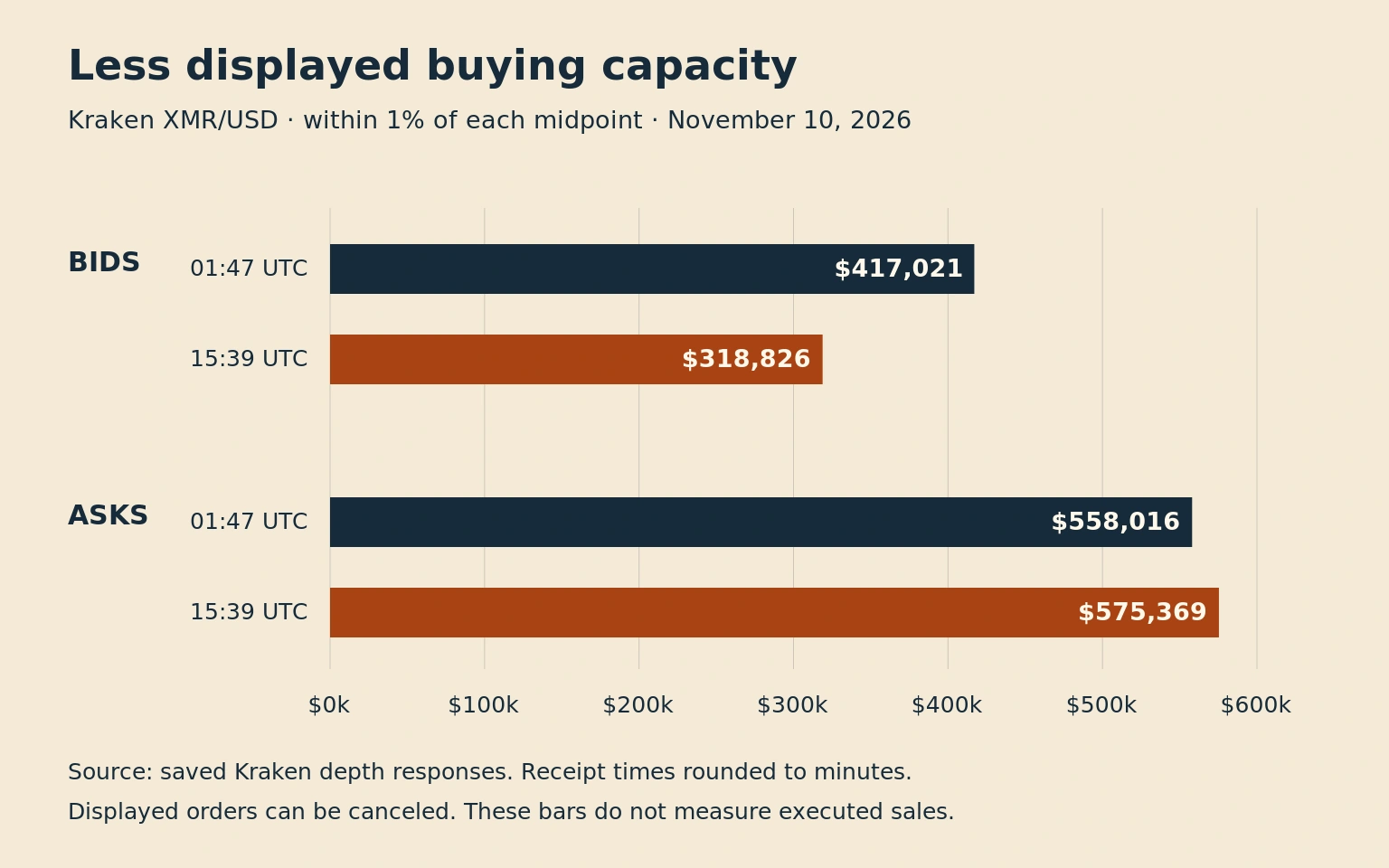
A bid is an offer to buy at a stated price. If sell orders consume nearby bids faster than buyers replace them, executions can move down the book. The smaller later snapshot is consistent with less displayed buying capacity near the market. The snapshots leave the duration unknown, along with whether execution, cancellation or repricing removed those orders.
Traders can cancel orders before execution. Hidden orders and other venues are outside this measurement. Neither this chart nor a large visible order establishes an executed whale sale.
Liquidations point to pressure, not the first trigger
CoinGlass's page, marked updated at 15:40 UTC, reported roughly $1.83 million in rolling 24-hour XMR liquidations, including $1.72 million of longs, about 94%. It listed $345.21 million in dollar open interest. Its headline showed a 9.51% daily OI decline, while its automated explanation showed 0.66%. The page does not distinguish the two measures. CoinGlass XMR data.
A liquidated long is a leveraged position forced closed as its margin becomes inadequate. Forced closures can amplify an existing decline, but a daily total does not reveal the first trigger or the sequence of selling.
Falling prices reduce dollar open interest even with unchanged contracts. Dividing the displayed OI ratio, 0.9049, by the price ratio, 0.9109, gives about -0.66%. A price adjustment could explain the smaller figure. That calculation cannot verify contract counts or changes in venue coverage. The page's accessible venue table was empty. Public derivatives exposure does not measure private XMR holdings.
Differences between overlapping rolling 24-hour totals are not exact intervening activity: older events leave the window as new ones enter. Nor can changing samples on a whale tracker establish fresh purchases by the same holders.
Mining estimates move on a different clock
At reference block 3,803,414, difficulty divided by Monero's 120-second target gave an estimated 6.743 GH/s. The three P2Pool observer endpoints reported that same mainchain reference. Its height, hash and difficulty also matched the site's node-backed block lookup.
| Network or sidechain | Difficulty-derived estimate | Share of network estimate |
|---|---|---|
| Monero network | 6.743 GH/s | 100% reference |
| P2Pool main | 479.14 MH/s | 7.106% |
| P2Pool mini | 31.67 MH/s | 0.470% |
| P2Pool nano | 5.46 MH/s | 0.081% |
| P2Pool combined | 516.27 MH/s | 7.656% |
Sources: main observer, mini observer and nano observer. One observer service operates all three endpoints. Independent confirmation of the sidechain figures remains unavailable. Their sidechain timestamps span 43 seconds.
The earlier record put the network at 6.695 GH/s and combined P2Pool share at 8.012%. The later estimates show a slightly higher network figure and a lower combined share, by 0.355 percentage points. Main and mini estimates fell, while nano's rose. Establishing miners leaving P2Pool, an outage or a response to XMR's price requires longer observations and operational evidence.
Mining difficulty reflects preceding block arrivals. Dividing it by the target interval produces an estimate with smoothing and random timing effects, and cannot directly count active hardware. P2Pool estimates here use each sidechain's difficulty and target: 10 seconds for main and mini, 30 for nano. Their difficulty histories differ from Monero's and from one another.
P2Pool's payout window determines which shares can receive a reward. The hashrate estimates do not share that measurement window. The P2Pool source code handles those calculations separately. Our P2Pool monitoring guide explains why share and block observations need context.
Explanations ranked by the evidence
| Explanation | Evidence and confidence |
|---|---|
| Long liquidations added selling pressure | Plausible amplifier. CoinGlass reports predominantly long liquidations, but coverage and sequencing limit causal confidence. |
| Less nearby buying capacity made selling harder to absorb | High confidence in the two Kraken snapshots. Limited confidence about persistence or conditions elsewhere. |
| A broader crypto decline explains part of the move | Bitcoin also fell, but far less over the aligned interval. It cannot account for the full relative decline. |
| Mining trouble caused the sell-off | Unsupported by this collection. Difficulty estimates alone cannot establish an operational incident. |
| Arkéa-related flows caused this fresh decline | Unestablished. The bank incident is older, and no verified trading sequence links it to this window. |
The strongest evidence concerns what accompanied the decline. Identifying the initial sellers and their motivation would require trading evidence absent from these records. Testing a price/hashrate relationship would require more than the two pool snapshots available here.
Arkéa confirmed the attack on November 4
Crédit Mutuel Arkéa confirmed the attack in its November 4 announcement. Its follow-up statement says attackers used its own account for transfers to other banks, potentially enabling later cryptocurrency conversion. It did not confirm the precise €118 million/$133 million figure put to it, only the approximate scale. It also said it had blocked some funds and was pursuing recoveries.
Bitquery's November 5 investigation separately counted $126.04 million in USDC withdrawals to 17 wallets. That investigator's flow total remains unreconciled with the bank's final loss. This edition has not independently reproduced its address attribution.
The bank's statements do not name Monero. Those statements establish neither conversion of the entire theft amount into XMR nor a trace of onward private Monero transfers. Our Arkéa reporting separates the bank's account from the crypto-tracing claims. Recycling the older incident supplies no evidence that it caused today's selling.
What to watch next
Repeated depth measurements. Check whether bids replenish at Kraken and whether other accessible venues show similar spreads and depth. Use equal relative-price bands and record timestamps for each observation.
Reproducible derivatives records. Venue-level liquidation events and contract counts would help distinguish forced closures from price-driven changes in dollar exposure. Establish which CoinGlass OI percentage uses dollar value and which adjusts for price before drawing a conclusion about positioning.
A longer mining record. Save compatible Monero and sidechain observations over successive difficulty cycles, alongside node and pool health evidence. The network and pool views offer follow-up observations, not proof of miner identities or motives.
Dated primary announcements. At this cutoff, the latest stable releases returned by the official repositories were Monero v0.18.5.4, published October 17, and P2Pool v4.18.1, published September 22. Both releases predate this price window. Check the official Monero blog and release records before attributing a market move to new software or a security event.
Measurement notes
The supplied 13:34 UTC monitoring snapshot was a research lead. Its exact historical book and liquidation totals could not be independently replayed from the available endpoints. This edition instead uses saved fresh responses and the earlier series archive. Similar rounded totals at a later time do not authenticate the earlier snapshot.
The draft's research record retains raw responses, retrieval times, source dates, hashes and calculation code. The order-book timestamp is receipt time, not a claimed exchange-wide atomic timestamp. Price comparisons use October 11, November 3, November 9 and November 10 closes at 15:00 UTC.