Monero Signal / Markets / Mining
Monero Signal: XMR Falls Against Dollars and Bitcoin
XMR fell against USD and BTC on Kraken. Monero Signal compares market activity with P2Pool estimates, dated sources and the limits of the available data.
Monero Signal · Price, mining power, and the stories behind the moves.

XMR lost ground against both the dollar and bitcoin on Kraken over the last complete 24-hour window. Bitcoin becoming cheaper in dollars cannot alone explain both declines. The exchange data covers two trading pairs, with traders and their motives unidentified.
Monero Signal follows price, mining power, and the stories behind the moves. This first edition establishes a network and liquidity baseline. Market comparisons end at 01:00 UTC on November 10, 2026. We collected the order book and P2Pool observations around 01:47 UTC, after the market comparison window closed.
Market snapshot
The table uses Kraken's XMR/USD hourly candles and XMR/BTC hourly candles. Each price is the last trade in a completed hour. We exclude the unfinished hour, following the exchange's candle documentation.
| Metric | Latest observation | 24-hour change | 7-day change | 30-day context |
|---|---|---|---|---|
| XMR/USD | $583.08 | -2.93% | -3.51% | +12.46% at 00:00 UTC |
| XMR/BTC | 0.007771 BTC | -3.12% | -1.27% | +23.48% at 00:00 UTC |
| XMR/USD traded volume | 4,915.12 XMR | +83.46% | -70.38% | Unavailable |
| XMR/BTC traded volume | 915.86 XMR | +74.59% | -29.21% | Unavailable |
| XMR/USD spread | $0.87 / 14.92 basis points | Unavailable | Unavailable | Baseline |
Volume is the sum of trades in the 24 hours ending at the cutoff. Its changes compare that window with the preceding 24 hours and with the matching 24-hour window seven days earlier. Other venues fall outside these volume figures. Both 30-day comparisons use daily closes ending at 00:00 UTC, one hour earlier than the headline window.
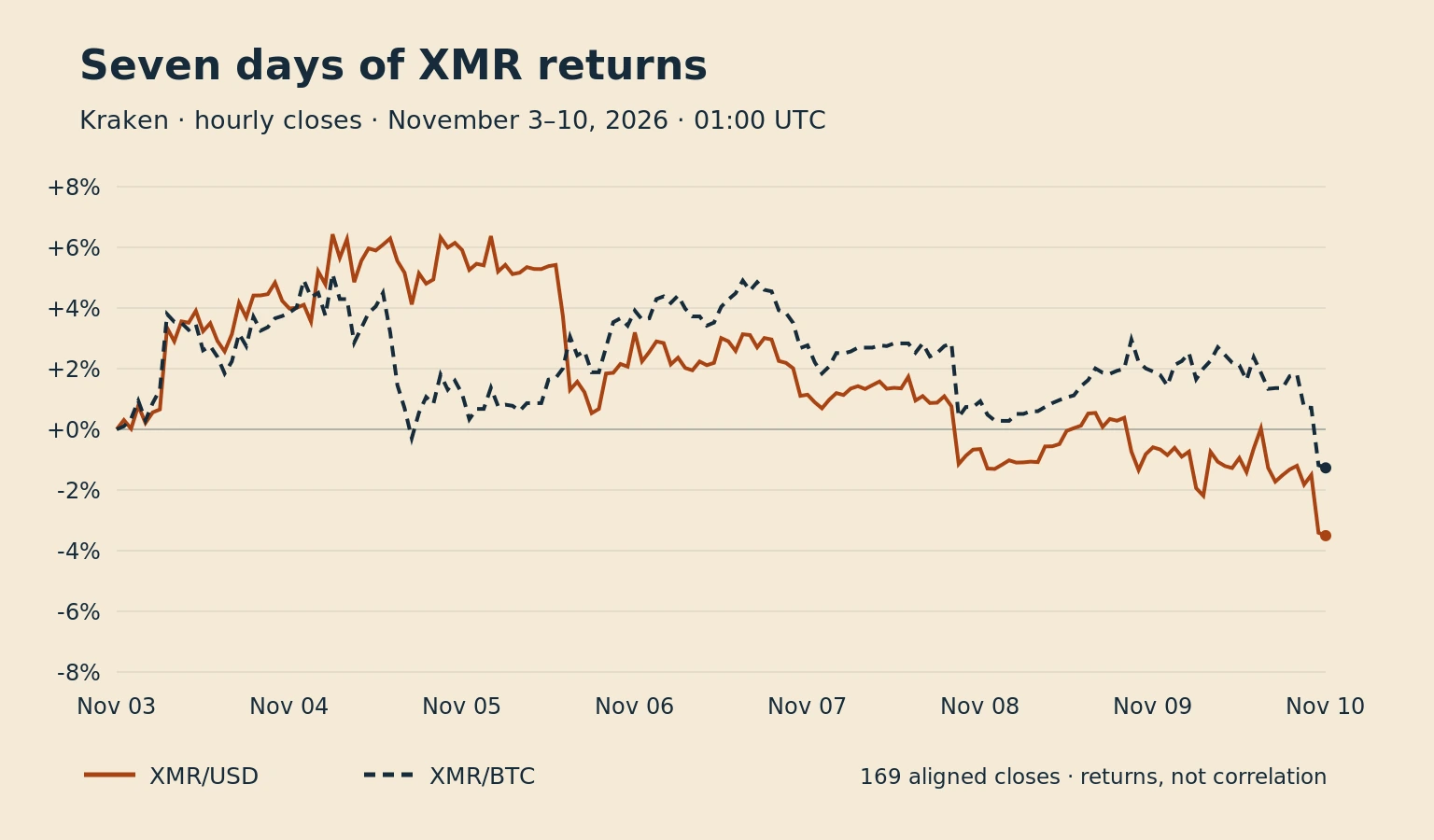
The chart rebases each pair to its own starting close on November 3 at 01:00 UTC. It shows cumulative percentage returns across 169 aligned observations. It does not calculate a correlation or identify the cause of either move.
The XMR/USD order book showed a best bid of $582.72 and ask of $583.59. Within 1% of their midpoint, displayed bids totalled about $417,021 and asks about $558,016. Both sides of the downloaded book extended beyond that band.
Those totals describe visible resting orders at receipt time. Orders can disappear before execution. The figures exclude hidden orders and fees. More displayed asks than bids in one snapshot does not establish sustained selling pressure. The last traded price and current quotes can differ because they describe different events.
Network and P2Pool
The main, mini and nano observers agreed on Monero block 3,802,996, including its hash and difficulty. A separate node-backed block lookup corroborated that reference. These observer endpoints belong to the same observer service, so their agreement is not three independent confirmations.
| Metric | Snapshot estimate | 24-hour change | 7-day change | 30-day context |
|---|---|---|---|---|
| Monero difficulty | 803,430,829,609 | Unavailable | Unavailable | Baseline |
| Network hashrate | 6.695 GH/s | Unavailable | Unavailable | Baseline |
| P2Pool main | 497.762 MH/s / 7.435% | Unavailable | Unavailable | Baseline |
| P2Pool mini | 33.324 MH/s / 0.498% | Unavailable | Unavailable | Baseline |
| P2Pool nano | 5.314 MH/s / 0.079% | Unavailable | Unavailable | Baseline |
| Combined P2Pool share | 8.012% | Unavailable | Unavailable | Baseline |
Network hashrate is reference-block difficulty divided by the 120-second target interval. Each P2Pool estimate divides its sidechain difficulty by its own target: ten seconds for main and mini, thirty for nano. The combined share adds those three estimates and divides by the same network estimate. Network hashrate already includes P2Pool mining.
The observations span 188 seconds. That supports a snapshot comparison, but their difficulty algorithms smooth different histories. These figures are neither identical-window measured averages nor shares of payouts received during the day. We have not established a comparable historical series for this edition, so missing changes remain unavailable.
A delayed block alone cannot establish an outage. Block discovery is random, and a smaller sidechain can go longer between Monero block rewards. The P2Pool documentation explains its share and payout model. Operators can use the P2Pool setup guide and monitoring guide to investigate local problems. Establishing miner migration or an attack would require observations over time and evidence beyond these totals.
News and reported large flows
Monero's enrollment in Anthropic's OSS Scanner merged on November 6 at 18:56 UTC. The merge confirms enrollment. Results from any completed audit would need their own evidence. The enrollment record also says nothing about its effect on trading.
The current stable release references remain Monero v0.18.5.4, published October 17, and P2Pool v4.18.1, published September 22. Both releases predate the comparison window.
Crédit Mutuel Arkéa's November 4 account of its theft says transfers from the bank's own account may then have allowed conversion into cryptocurrency. It does not identify Monero. The bank also declined to confirm the exact €118 million figure put to it, while acknowledging the order of magnitude and efforts to recover funds.
That statement cannot establish an XMR purchase amount, a laundering route or an explanation for this price move. This edition has no independently verified large XMR purchase to report. A public derivatives position would establish exposure on its venue, not private XMR holdings or onward transfers.
Observations and possible explanations
High confidence, narrow scope: XMR underperformed both quote currencies on the measured Kraken pairs. Trading volume rose against the previous day's low base but was lower than the matching window a week earlier. Calling this simply a volume surge would lose that context.
Cause unresolved: ordinary changes in trading demand, venue-specific liquidity and different participants executing at different times could all contribute. The available candles do not identify the traders. The positive 30-day dollar context also cautions against treating one down day as a complete description of the market.
No aligned historical mining series supports a price-hashrate correlation here. Nor does a security headline supply the missing trade evidence. The network snapshot and news explain what else was observable, not what caused the decline.
What to watch next
The next edition should compare the same UTC market windows and collect another dated order book before describing a liquidity trend. Repeated P2Pool observations will help distinguish persistent share changes from short-window variance. Any purchase or laundering claim needs evidence connecting the amount, asset and event before it belongs in the market explanation.
Browse Monero Signal editions and sources. The live network page and pool comparison show newer observations. This edition records the earlier, dated snapshot.