Monero Signal / Markets / Mining
Monero Signal: XMR Recovery and Verified Short Covering
XMR recovered as one public Hyperliquid account reduced its short. Dated price, liquidity and P2Pool data show what changed and what remains unknown.
Monero Signal · Price, mining power, and the stories behind the moves.

XMR recovered 6.98% against the dollar over 24 hours on Kraken. Separately, Hyperliquid's public records show one account closing 8,508.435 XMR of short exposure through 5,813 fills on November 11, with about $4.85 million in contract notional. The covering is verifiable. Its contribution to the price recovery is not.
Monero Signal follows price, mining power, and the stories behind the moves. This edition's research cutoff is 17:36 UTC on November 11, 2026. Market returns use completed hourly candles ending at 17:00 UTC. We captured order books and account data around 17:34 UTC. These observations describe that collection window.
XMR recovery in context
| Kraken market | Close at 17:00 UTC | 24h | 7d | 30d |
|---|---|---|---|---|
| XMR/USD | $593.05 | +6.98% | -6.67% | +11.99% |
| XMR/BTC | 0.007993 BTC | +4.33% | +0.85% | +23.50% |
| BTC/USD | $74,190.70 | +1.89% | -7.80% | -9.96% |
Calculations use Kraken XMR/USD candles, XMR/BTC candles and BTC/USD candles. Each return compares closes at the same UTC hour. Archived responses from the previous editions supply the 30-day baselines beyond the API's rolling history. These are separate traded pairs, so their last-trade returns need not reconcile exactly through currency conversion.
The rebound leaves XMR below its dollar price a week earlier. Bitcoin also rose over the daily window. Meanwhile, CoinGecko's global market series, timestamped 17:33 UTC, reported total cryptocurrency capitalization down 0.57% over its rolling 24 hours, at about $2.50 trillion. Its coverage and timing differ from the Kraken candles.
Kraken's XMR/USD pair traded 8,033.88 XMR in the 24 completed hours, about $4.59 million in turnover calculated from hourly volume and volume-weighted prices. Base-asset volume fell 22.92% against the preceding nonoverlapping day. CoinMarketCap separately reported $170.79 million in aggregate rolling volume at 17:35 UTC. Its wider venue coverage does not turn the smaller Kraken figure into a contradiction.
A tighter spread, with less displayed depth
The Kraken order book captured at 17:34:34 UTC had a $592.22 best bid and $593.01 best ask. The spread was 0.133% of their midpoint. Orders within 1% of that midpoint totaled about $256,000 in bids and $285,000 in asks.
In the previous edition, the November 10 afternoon snapshot showed about $319,000 in bids and $575,000 in asks, with a 0.204% spread. Today's spread was tighter, but displayed dollar depth fell on both sides. The snapshots do not distinguish executions from cancellations or orders moving outside the band. That band moves with price. Market-wide liquidity remains unmeasured here.
Verified short covering by one public account
We queried Hyperliquid for account 0x880ac484a1743862989a441d6d867238c7aa311c, using its documented fills and account-state API. The time query covered November 11 from midnight through 17:34:33 UTC. The four response pages contained 6,100 records across assets. Removing four repeated boundary records left 6,096 unique fills.
Of those, 5,813 were XMR fills labeled Close Short, from 00:00:02 through 16:55:18 UTC. Their sizes summed to 8,508.435 XMR of contract exposure. Summing each size multiplied by its execution price gives approximately $4.85 million in quoted notional, not profit or cash withdrawn.
The signed XMR position before the first observed fill was -16,376.822. The closing fills reconcile without a position gap to -7,868.387, which matches the separate account-state response timestamped 17:34:40 UTC. The account was still short. Every retrieved XMR fill in this interval closed part of the short.
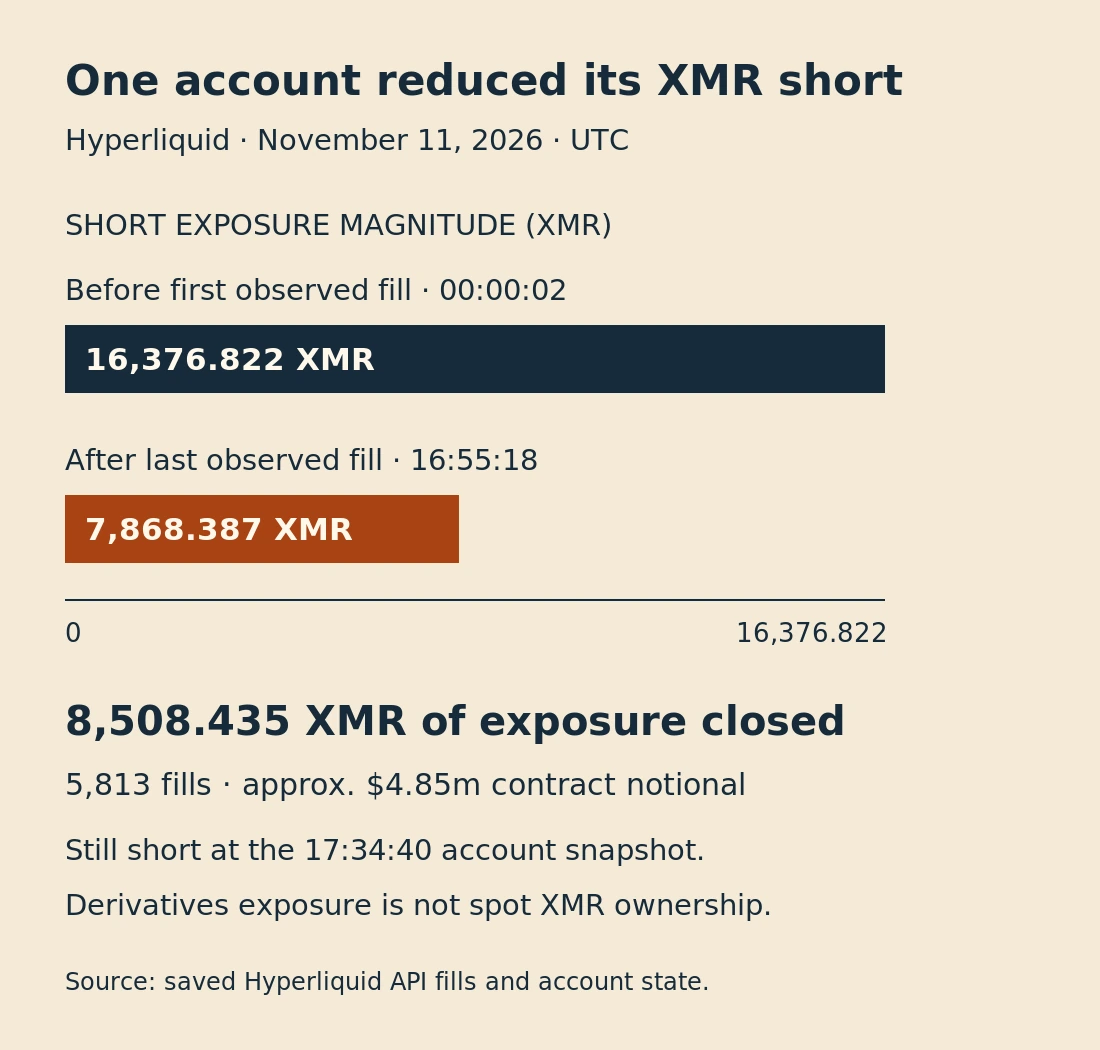
The fills concern perpetual derivatives. Hyperliquid's contract specifications describe stablecoin collateral and contract pricing. Buying to close reduces contract exposure without acquiring spendable spot XMR. The records leave the account owner's identity, wider exposure and private Monero transfers unknown. Classifying the closures as forced liquidations would require additional evidence.
Coverage beyond the capped sample
The refreshed latest-fill endpoint returned exactly 2,000 records, including 1,944 XMR closing fills. Those represented 3,054.694 XMR of exposure and about $1.77 million in notional between 06:46:40 and 16:55:18 UTC. The 1,944 count measures executions. Their quantities add up separately.
The earlier monitoring note described 1,944 fills and roughly $1.79 million over 06:16 to 16:23 UTC. Its raw response was not supplied, so we cannot independently reproduce that exact window. A capped response changes as newer fills displace older ones. The fresh pages establish a larger observed total without treating the earlier sample as a complete trading history.
Hyperliquid documents at most 2,000 fills per time-query response and access to only the latest 10,000 fills. Pagination reused each final timestamp as the next inclusive boundary. We removed duplicate asset/trade-ID/transaction-hash combinations and confirmed that the pages included every XMR fill from the latest sample. Position continuity strengthens the reconciliation for this interval. It does not establish lifetime completeness, earlier trades or activity on other accounts and venues.
Mining power and the three P2Pool sidechains
| Network or sidechain | Estimated hashrate | Estimated network share |
|---|---|---|
| Monero network | 6.580 GH/s | 100% denominator |
| P2Pool main | 479.740 MH/s | 7.291% |
| P2Pool mini | 31.356 MH/s | 0.477% |
| P2Pool nano | 5.128 MH/s | 0.078% |
| P2Pool combined | 516.224 MH/s | 7.846% |
Sources are the main, mini and nano observers. Their sidechain timestamps span 17:33:17 to 17:34:32 UTC. Main and mini referenced Monero height 3,804,186, while nano was one block behind. We used one common denominator, the difficulty at height 3,804,186 divided by the 120-second target, corroborated against our node-backed block response. The 75-second timestamp spread makes the combined share approximate. All observer endpoints share an operator.
For each sidechain, we divide difficulty by its own target: 10 seconds for main and mini, 30 for nano. Target intervals are not averaging windows. Monero's difficulty rules use a 720-block window with lag and timestamp trimming. P2Pool's calculation uses sidechain history, uncle blocks and its own trimming. Its payout window serves a separate purpose, even where the configured window length also enters difficulty calculation. Both estimate hashing work rather than count active machines.
Compared with yesterday afternoon, the combined P2Pool estimate was nearly unchanged at about 516 MH/s. Its share rose from 7.656% mainly because the estimated network denominator fell from 6.743 GH/s. This comparison cannot establish miner migration to P2Pool. See our P2Pool guide for how shares and payouts work.
Confidence and the next checks
The strongest findings are a daily recovery on Kraken and a reconciled reduction in one account's derivatives short. They occurred during the same day, but these records do not establish that the account caused the rally. Lower Kraken volume, reduced displayed depth and the remaining short position are counterevidence to a simple story of broad, sustained buying.
The Monero release record still identified v0.18.5.4, published October 17, and P2Pool's identified v4.18.1, published September 22. Neither is a fresh release in this observation window. Our review of those records and the official Monero blog established no fresh, independently corroborated project event that explains this move.
Further observations can show whether the account reduces its short again, whether displayed depth persists and whether the network estimate stabilizes. The present record is insufficient for a causal or correlation estimate.