Monero / Privacy
What Are Atomic Swaps? Bitcoin, Monero and BasicSwap
Understand Bitcoin and Monero atomic swaps, compare BasicSwap with eigenwallet, and learn how fees, refunds and wallet backups affect a trade.
Monero / Atomic Swaps / Wallets
Eigenwallet seeks 484.88 XMR for browser-based Bitcoin swaps, Ethereum support and related work. See what 5.0.5 ships and which security questions remain.
Eigenwallet is seeking 484.88 XMR from Monero's Community Crowdfunding System (CCS) for six months of work that includes Bitcoin-to-Monero swaps in a browser extension and a separate Ethereum-to-Monero client. Its November 23 desktop release, 5.0.5, already enables encrypted swap backups by default for new graphical-wallet swaps and improves cancellation, refunds and reconnection. The funding request is open and remained in Ideas on November 26, 2026 UTC. CCS request #709 · CCS Ideas · Eigenwallet 5.0.5
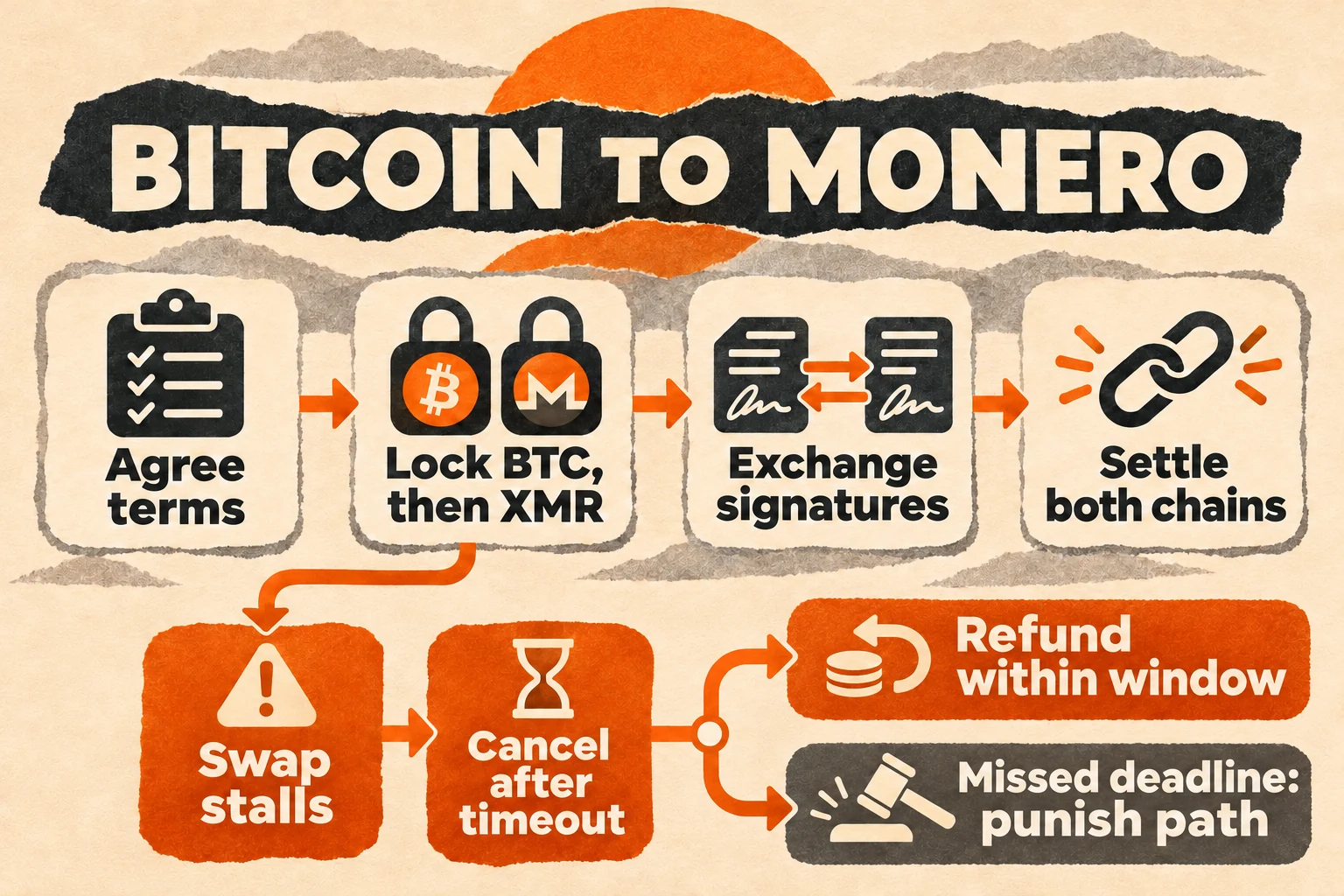
Eigenwallet's desktop app buys XMR with BTC from a peer running the separate maker software. The taker funds an internal Bitcoin wallet and accepts a quote. The parties prepare recovery transactions, lock BTC and XMR on their respective chains, and exchange cryptographic material. An adaptor signature links the two spends. When the maker spends the Bitcoin using the completed signature, the taker can extract a secret needed to spend the Monero. Traders settle from their own wallets without depositing at an exchange or into a shared liquidity pool. Eigenwallet protocol · Bitcoin and Monero protocol paper · Monero Love atomic swap guide
If a funded swap stalls, either side can publish the prepared Bitcoin cancel transaction once its timelock matures. The taker then publishes a separate refund, which allows the maker to reclaim locked Monero. Eigenwallet documents a 30-confirmation delay before cancellation for new swaps and a 144-block refund window after cancellation confirms. If the taker misses that window, the maker can take the BTC through the punish path, and recovering the XMR can require the maker's cooperation. Network fees and any agreed anti-spam deposit can affect what the taker recovers. Refund and punish rules
BasicSwap 0.19.2, released November 10, is another maintained option. It supports BTC/XMR in both directions and a wider set of assets. Its browser interface talks to a locally installed swap client and wallets. Users can run their own backends or use Electrum and a remote Monero node in lightweight configurations. Offers and negotiations use a distributed messaging layer, with Tor configurations available. Both clients keep custody with traders. BasicSwap's backup instructions call for preserving the data directory for active trades, while Eigenwallet can reconstruct supported swaps from an Apollo backup and the seed. The archived COMIT code is a predecessor to Eigenwallet. A standalone extension could simplify installation compared with either maintained client, while adding a website-facing approval boundary. BasicSwap release · BasicSwap backup documentation · BasicSwap Tor documentation · BasicSwap on Whonix and Tails · BasicSwap upgrade coverage · COMIT archive
The original November 16 submission asked for 525.58 XMR. The November 25 commit cut the total by 40.70 XMR by replacing a 200 XMR browser milestone with 159.30 XMR in hourly payments. The 200 XMR Ethereum milestone is separate and remains in the request. Original submission · November 25 revision
| Work | Requested XMR |
|---|---|
| Ethereum-to-Monero swaps | 200.00 |
| Browser extension | 159.30 |
| Security research | 57.35 |
| Protocol and desktop GUI | 38.23 |
| Maker peer-to-peer microservice | 15.00 |
| Maker migration to monero-oxide | 15.00 |
| Total | 484.88 |
The browser budget covers six 26.55 XMR payouts for 200 hours each. The team says it will request the first payout only after releasing an extension that users can complete a mainnet swap with. Security and protocol work together amount to six 15.93 XMR payouts after 120 hours and a public monthly report. Each maker refactor and the Ethereum integration has a deliverable-based milestone. The proposal expires August 31, 2027 UTC. Its six months describe the work budget. The mainnet payment gate leaves the launch date and independent acceptance criteria open. Proposal and payout terms
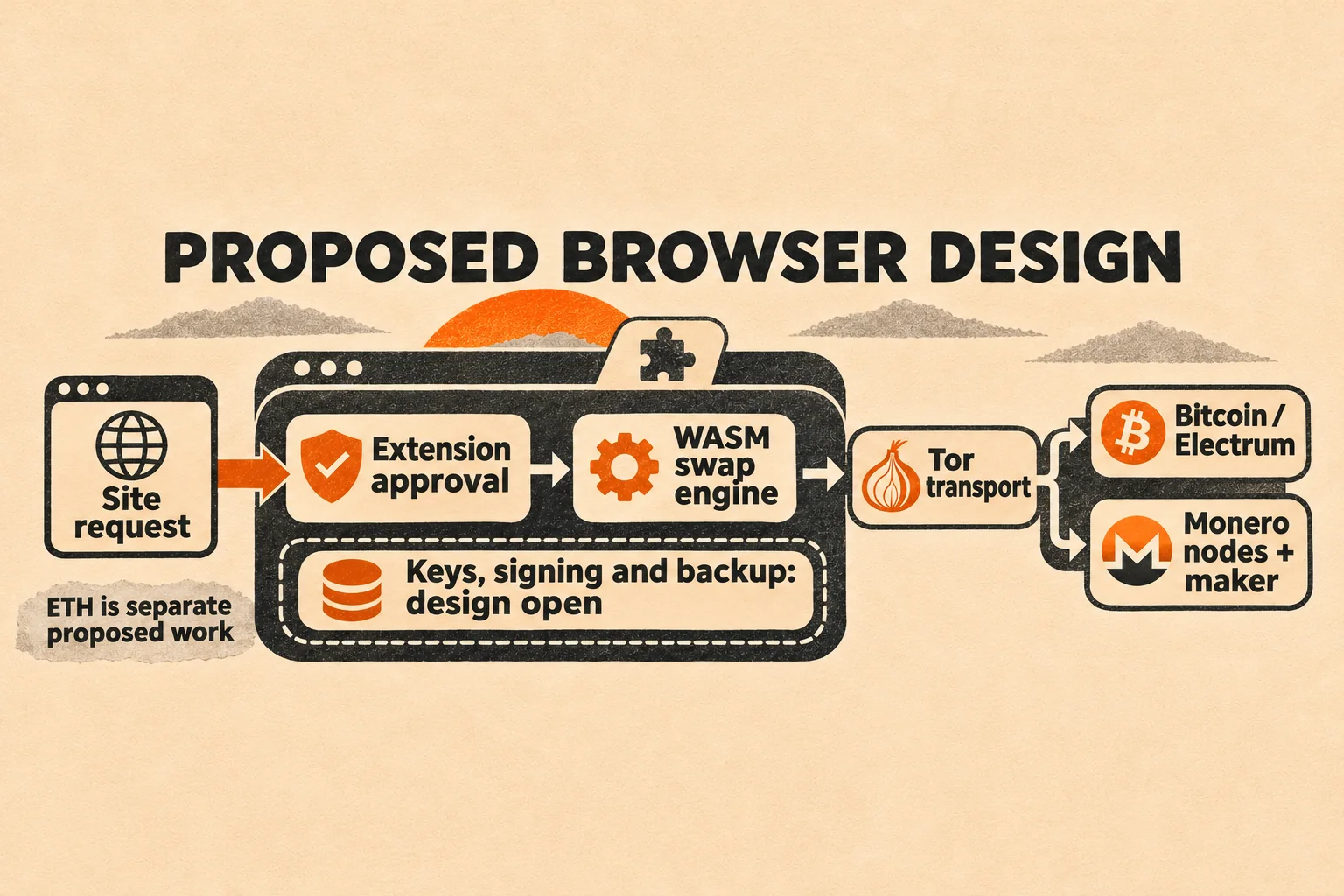
The proposed Eigenwallet browser atomic swaps would begin with a request from a maker's website and require approval inside the extension. The team proposes compiling the Rust swap engine to WebAssembly (WASM) and delegating networking, storage, Tor and Monero bindings to the host through a JavaScript bridge. A native wallet could use a native build of the same engine. The November 19 revision removed the Firefox-specific wording. The proposal discusses Tor Browser and leaves the full browser list and permissions open. Proposal and developer discussion · November 19 revision
A reviewer from MoneroSwap pointed to an OrangeFren Firefox experiment. Eigenwallet's maintainer confirmed work on an experimental prototype and described a move away from holding keys in a web app. The endpoint did not load during this review. Public source code for the experiment and a reproducible mainnet package remain unverified after a review of the project's public repositories and a sample of core branches. The proposal's mockups and developer comments leave open what the prototype signed and which network it used. Proposal discussion · Eigenwallet repositories
A browser can suspend background code between confirmations. Chrome documents that extension service workers can lose their in-memory state on shutdown. Before broadcasting, the engine would need to save the approved terms, signed transactions and deadlines to durable storage. On restart it would reconcile that record against both chains. If a server received a transaction but the browser closed before seeing the reply, resuming must avoid creating a second payment. Deleting the browser profile removes local extension state. Apollo could recover eligible Bitcoin swaps after the wallet locates their backup. The team also describes encrypted multi-device sync as unreleased. Either approach still needs time to restore and act on a refund. Chrome worker lifecycle · Eigenwallet backup proposal
Eigenwallet's ETH integration is at the proposal stage. The sources reviewed identify no Eigenwallet testnet build or mainnet contract. Elizabeth Binks' paper describes the underlying construction, and AthanorLabs' archived repository contains an earlier runnable client. The idea is to lock ETH in a contract and lock XMR under a Monero key assembled from both parties' contributions. A valid claim of the ETH reveals a secret contribution that lets the taker spend the XMR. A valid ETH refund reveals the taker's contribution so the maker can recover the XMR. Monero has no general-purpose contract that can directly mirror Ethereum's conditions. The key relationship and proofs tie the chains together. A conventional hashlock verifies a preimage, while a timelock governs when a path opens. The actual contract must specify how it verifies the secret and which transitions it permits. Binks' Ethereum and Monero paper · AthanorLabs source
If a participant disappears after funding, the other needs an enforceable claim or refund they can execute independently. Reviewers need to check what happens if either side vanishes at each stage. They also need to check whether a reorganization can expose a secret before finality and whether congestion or gas prices can strand a refund. Ethereum exposes contract calls, accounts, amounts and timing. Even with Tor and off-chain offers, an observer could correlate that data with maker activity. A deployed contract needs a verifiable address and bytecode, with explicit rules for upgrades and administrator powers. Independent reviewers should examine the contract and the off-chain state machine together. Ethereum transactions · Ethereum finality
MoneroSwap's developer questioned the cost, the choice to write another contract and the risks of generic token support. Eigenwallet's response favors a purpose-built contract, existing peer-to-peer discovery and its own anti-spam provisions. Prospective liquidity is developer-reported interest. The offer network, liquidity, token support and audit scope would each need separate evidence. The proposal discusses auditing and leaves the reviewer and sign-off process open. Proposal and review comments · MoneroSwap source
An extension can have fewer operating-system privileges than a native app. It adds a path from untrusted websites into software that signs transactions. A content script can relay a request from the page, but isolated JavaScript environments still share the page's DOM. The extension should check the origin, reject unsolicited or replayed requests and show the amount, fees, network and destination in its own interface. A phishing site can imitate a wallet prompt, and clipboard malware can substitute an address. A site-supplied recipient deserves the same independent check as a pasted one. No reviewed manifest, signing API or wallet integration established these protections for Eigenwallet's proposal. WebExtensions content scripts
WASM memory belongs to the extension runtime. A host with access to exported memory or privileged signing functions can still reach secrets or misuse them. An isolated signer, a cryptographically secure random source, minimal host imports and short-lived buffers would reduce exposure. Reviewers would need to see where the extension creates keys and which cryptographic operations run in WASM. They should also check for secret copies in JavaScript, logs and crash dumps. At-rest encryption can protect a copied profile or backup while locked. A hostile extension with broad privileges, session malware or a compromised automatic update may still capture approval data or use an unlocked signer. Reproducible builds help reviewers compare packages with source. Store accounts and signing credentials still need protection. Browser updates and dependency provenance also affect package safety.
Those are design risks. Eigenwallet has separately documented a May 2026 incident that burned maker funds, and earlier fixes for a setup flaw and a Bitcoin fee race. History gives reviewers concrete reasons to check funded recovery and fee behavior. The documented incidents involve the existing swap software. Maintainer incident report · Earlier setup fix · Earlier fee-race fix
Eigenwallet introduced Apollo in 5.0.3. In 5.0.5 the GUI turns its optional on-chain backup setting on for new swaps by default. The code encrypts swap recovery state with ChaCha20-Poly1305 and a seed-derived key, then puts the encrypted payload in a Bitcoin transaction. The new default applies only to new swaps. The backup adds a Bitcoin fee and its transaction remains public. Restoration depends on finding the backup, retaining the correct seed and recovering before the protocol deadlines. Tagged Apollo source · GUI default change
The taker now recognizes a confirmed cancel even when the lock status is stale and retries inconsistent wallet state before refunding. The GUI and CLI skip onion maker addresses when Tor is off, and the client can try each maker address independently. The maker service floors rendezvous registration renewal at two hours. Across the GUI, CLI and maker service, the Monero RPC pool reconnects after a node closes an idle connection, and Bitcoin height tracking takes the highest Electrum tip reported instead of sticking to a stale first response. The latter improves availability. A reported height alone cannot authenticate the canonical chain. The GUI also accepts Taproot withdrawal addresses. The 5.0.5 notes and public advisory listing identify no newly disclosed vulnerability fixed in this tag. Release notes · Cancellation change · RPC reconnection · Public advisories
Turning off Tor makes the desktop client skip onion addresses. Eligible clearnet addresses remain usable. The GUI defaults to Tor for peer traffic and has a separate, off-by-default setting for Monero wallet RPC traffic. If the app cannot create the Tor client, it continues without it. A client that initializes but fails to bootstrap is a separate case. The Monero RPC pool accepts unverified HTTPS certificates, a policy present in 5.0.4 as well. HTTPS on that path does not authenticate the remote node. The proposed browser configuration uses Tor Browser and aims to send maker, Electrum and Monero traffic through Tor. The proposal leaves the proxy and DNS design open, including whether other browsers would use a separate SOCKS proxy and how connections would behave if Tor failed. Browser extensions typically use HTTP or WebSocket APIs. Raw Electrum TCP and arbitrary onion transports may need compatible endpoints or a separate bridge, each with its own trust implications. Desktop transport change · Tagged desktop configuration · Tagged RPC TLS code · Proposed transport
Privacy testing should observe DNS and outbound traffic on each supported browser during startup, reconnection and forced proxy failure. It should cover every maker, node, relay, backup and update connection involved. Even with correct routing, counterparties and remote endpoints see application-level activity, and public-chain timing can still link events. A website may learn that the user requested a quote and which maker they selected. Tor changes which parties can see the user's IP address. The protocol and the integration determine what else each party sees.
A tagged, reproducible extension build would let reviewers inspect its permissions and trace how it signs and stores transactions. Local-chain tests could show whether swaps survive restarts and profile loss. A separate Ethereum review needs a public protocol specification, deployed testnet bytecode and evidence of refunds under reorgs, stalled peers and high fees. This review inspected the tagged source and reproduced the idle RPC reconnect against a fake node on loopback. End-to-end wallet recovery and the application's outbound traffic remain unverified here.
An extension would remove a desktop installation step. Its value will depend on whether someone can recover a funded trade in time after a browser shuts down, a profile disappears or a backend drops offline. Version 5.0.5 improves recovery on the desktop. A successful mainnet swap would meet the proposed first browser payout condition, and independent tests would establish how the client handles failures.