Monero / Mining
XMRig 6.26.0 supports RandomX v2 testing
XMRig 6.26.0 remains the latest upstream release. Its RandomX v2 support is required for P2Pool's FCMP++ beta stressnet.
Monero / Mining / XMRig
Our Ryzen 9 7950X3D benchmark compares XMRig 6.27.0 with 6.26.0 using full huge pages. Hardware details, graphs and an explanation of the stable release fixes.

XMRig published stable version 6.27.0 on November 23 at 03:38 UTC. The release includes fixes for direct daemon connections, ARM performance work and updated FCMP++ solo-mining support for the beta stressnet. Existing miners should review the connection changes before restarting with the new version.
DaemonClient is XMRig's direct connection to a node for solo mining. Version 6.27.0 passes the configured TLS fingerprint into its HTTP requests, so the connection can check the expected certificate fingerprint. This matters when you rely on certificate pinning to identify your remote node.
The update also applies a configured SOCKS5 proxy to remote daemon HTTP requests and ZMQ connections. ZMQ supplies notifications about new work. Before this fix, these DaemonClient paths did not use the configured proxy. The new code resolves the proxy host and passes the destination to the SOCKS5 handshake. Localhost connections bypass the proxy.
A separate cleanup fix closes and frees the socket after a failed ZMQ connection and adjusts reconnect handling. This addresses a resource leak during connection failures. The release notes do not report confirmed interception or identify a CVE for these changes.
If your solo-mining setup depends on a proxy or certificate fingerprint, check those settings after upgrading. Watch the connection log as well as the hashrate. A running mining process alone does not show that the intended connection settings are in use. These fixes do not automatically enable a proxy or TLS for an unconfigured connection.
RandomX's just-in-time compiler, or JIT, turns generated mining programs into instructions the CPU can execute. This release changes how the ARM64 JIT loads and converts registers, aligns generated code and handles some immediate values. It also reduces JIT cache invalidation and adds ARMv9 CPU detection with adjusted build flags.
One change schedules the next dataset fetch earlier and uses non-temporal loads. The contributor's explanation is that dataset lines are not reused, so loading them should avoid displacing the scratchpad data the miner needs again. The contributor measured about an 8% hashrate improvement on a base Apple M4 against development revision 7eadfdc9.
That is a hardware-specific comparison, not a promised gain over your installed release. We should compare the same mining configuration on the same machine, with similar temperatures and background load. Record accepted work and power use alongside hashrate. The RandomX v2 optimizations prepare a separate algorithm version. They do not change the algorithm active on Monero mainnet.
ARM64 optimization and benchmark context · ARM64 register and generated-code changes
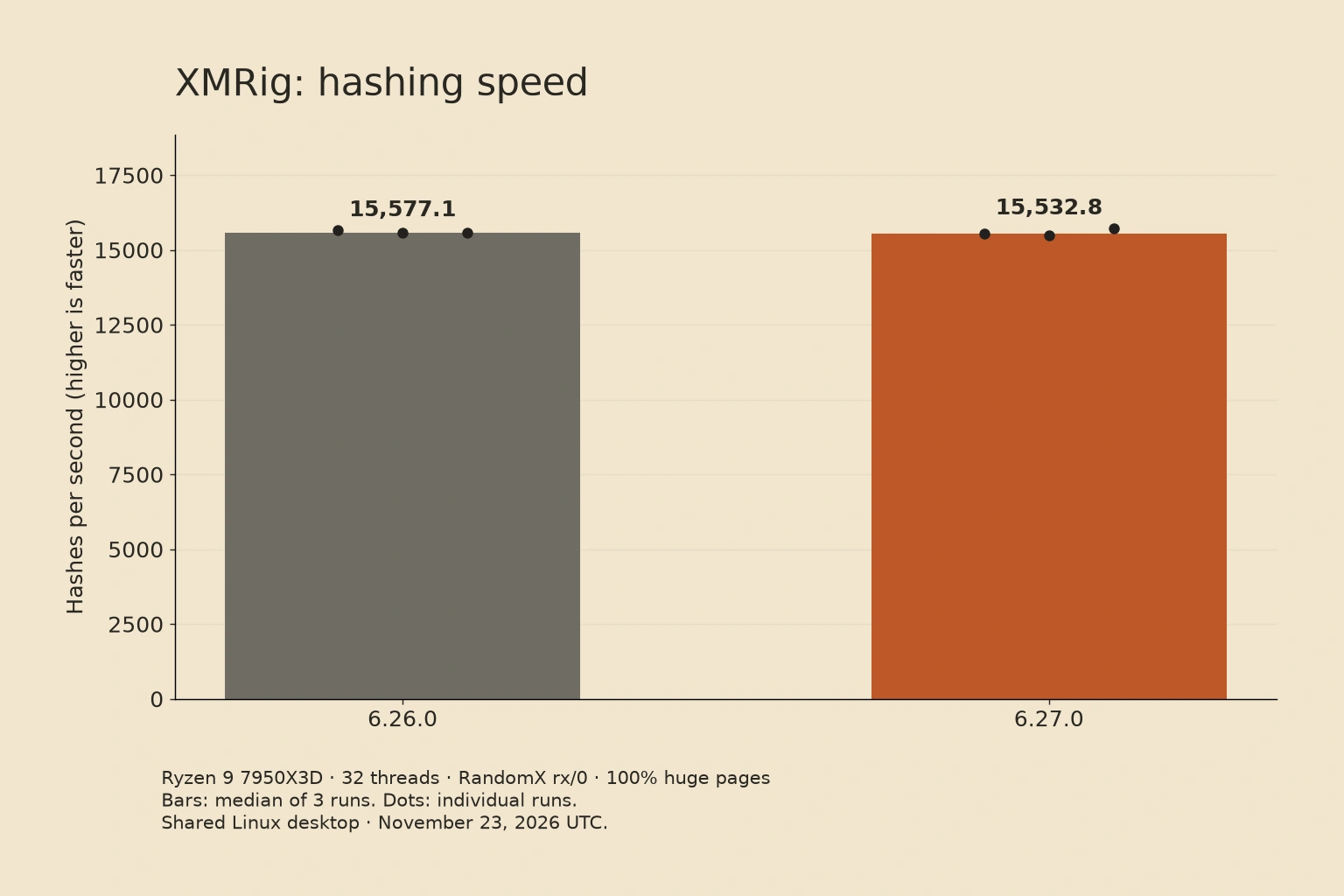
We compared the official Linux static builds of XMRig 6.26.0 and 6.27.0 with full huge pages on November 23, 2026 UTC. Version 6.26.0 returned a median 15,577.1 hashes per second. Version 6.27.0 returned 15,532.8, a 0.28% decrease.
Our test machine has an AMD Ryzen 9 7950X3D with 16 cores and 32 threads, plus 128 GiB of DDR5 RAM in four 32 GiB G.Skill modules. Firmware reports a configured memory speed of 3600 MT/s. We used an Arch Linux-based system with kernel 7.3.5-1.
Each version completed three offline RandomX rx/0 runs of one million hashes with 32 mining threads and 32 dataset-initialization threads. We used the same zero seed and configuration, with no pool connection or online benchmark submission. The run order was old, new, new, old, old, new. We checked the downloaded archives against the SHA-256 hashes on their release pages.
Every run used 100% huge pages for both the RandomX dataset and all 32 worker scratchpads. We temporarily increased the reservation from 1,195 to 1,201 pages of 2 MiB each and restored the original reservation after testing. Huge pages let the miner map larger memory regions with fewer page-table entries. These full-huge-page runs replace the earlier charts, whose worker allocation reached 81%.
We disabled the miner's MSR writes and kept the existing powersave governor. This was a shared desktop with background applications running. These results describe that setup, not the maximum performance of this processor.
The old version ranged from 15,567.1 to 15,657.3 hashes per second. The new version ranged from 15,491.9 to 15,719.3. The ranges overlap. Three runs per version cannot establish a small speed change independently of desktop load and thermal variation. The chart shows each run as a dot alongside the median.
Testing ARM64 performance would require an ARM machine. The offline benchmark exercises hashing, so the solo-mining TLS, proxy and reconnect fixes are outside its scope. We did not measure wall power, so these results do not establish energy efficiency. The official packages include different dependency versions, which means this compares the distributed builds rather than isolating one code change.
XMRig 6.27.0 benchmark and release downloads · XMRig 6.26.0 release and checksums
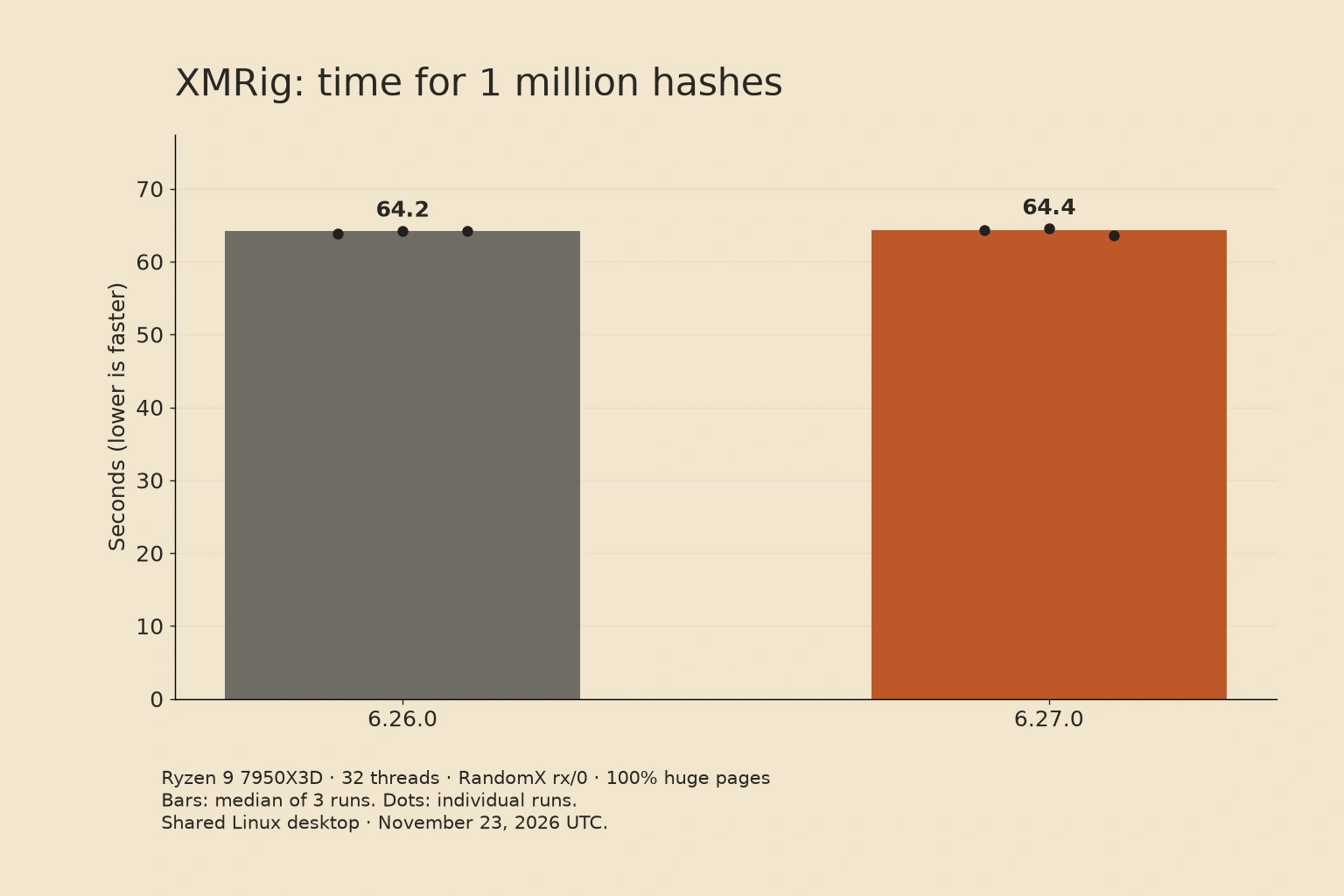
The second chart shows XMRig's measured time to complete one million hashes. Lower is faster. This is the same workload expressed as duration, not a second independent performance test. It excludes the separate dataset preparation stage. Every recorded run completed with the same benchmark checksum.
The release notes report 2.5% faster RandomX dataset initialization on RISC-V. Initialization prepares the dataset before mining can use it. That figure describes startup work, not a 2.5% increase in sustained hashrate.
The ARM and RISC-V JIT compilers also receive a fix for ISUB_R, a RandomX integer-subtraction instruction. The maintainer reports that an edge case in the old code could produce an invalid hash roughly once in 268 million hashes on those architectures. That makes it a correctness fix even when a miner appears to run normally. Another RISC-V change avoids indexed loads and stores in the RVV AES kernels, without a general hashrate claim.
RISC-V and JIT fixes · ISUB_R edge case and invalid-hash estimate
XMRig corrects its use of madvise, the operating-system interface for providing memory-management hints. The old code combined advice values as though they were bit masks. The fix sends them individually. It does not remove the need to check whether your own memory and huge-page settings work.
On macOS, a RandomX v2 assembler fix handles Apple's use of the semicolon character as a comment marker. This concerns compiling that code path. The ARM64 JIT cache change skips the unused gap between generated code and the literal pool when making code executable, while preserving write protection for the whole allocation.
Memory-advice correction · ARM64 JIT cache change · Apple assembler fix in the release notes
Version 6.27.0 updates the FCMP++ block-template layout and solo-mining code for beta stressnet v3. Miner compatibility with a test network does not activate a Monero mainnet upgrade. We found no confirmed mainnet activation date in the official announcements checked for this report.
Release notes and stressnet scope

For source builders, version 6.27.0 fixes OpenSSL 4.0 compatibility and builds using OpenSSL 3 or newer without the deprecated API. It also fixes compilation with libuv 1.53.0 on Windows and with Clang on Windows ARM64 under MSYS2.
MSVC builds now take hwloc from xmrig-deps instead of the bundled copy, so they need the new dependency package. The dependency build scripts move to libuv 1.53.0, hwloc 2.15.0 and OpenSSL 3.5.9 with unused features disabled. These versions describe the project's build scripts, not an instruction to replace system libraries independently.
macOS gains support for the new xmrig-deps package. The notes also say CMAKE_OSX_ARCHITECTURES=x86_64 alone can select an x64 build on Apple Silicon. That selects the target architecture. Native ARM64 downloads remain available for Apple Silicon.
Build fixes and dependency versions
The release page lists FreeBSD x64, Linux x64, macOS ARM64 and x64, and Windows ARM64 and x64 archives. It includes SHA-256 checksums and a PGP signature, with links to the project's signing key. Choose the archive for your operating system and CPU, then verify it before replacing the binary.
Save your current configuration first. After restarting, confirm the version and review rejected work, repeated reconnects and proxy or TLS errors. Compare performance over a representative interval instead of judging the first number printed after startup. Our XMRig monitoring guide explains which counters help separate hashing performance from connection trouble.