Monero / Mining / Security
What Happened to Qubic's Monero 51% Attack?
Examine Qubic's Monero 51% attack claims against recorded block shares, the September 2025 reorganization, and research on its mining rewards.

Qubic made plenty of noise about taking over Monero in 2025. Its August 12 press release announced a successful “51% takeover” demonstration and described the operation as happening in a “controlled environment.” That is an awfully comfortable description when the network being disrupted belongs to other people. Qubic's announcement.
Qubic's Monero 51% attack claims went further than the evidence supports. The attacks disrupted the network, but the measurements examined here do not show that the pool kept control of most mining power. The takeover headlines left that claim unresolved.
How Qubic used selfish mining against Monero
The project directed computing power into Monero mining and used the proceeds within its own token economy. Its August 28 recap described selling mined Monero, purchasing QUBIC, and burning the purchased tokens. The same update said its Monero experiment was continuing and reported orphaning nine blocks across three occasions. Epoch 175 mining recap.
The tactic was selfish mining. Instead of immediately sharing newly found blocks, a miner withholds them and builds a competing branch. Releasing that branch when the competing branch has more accumulated work can displace blocks from other miners. Its announcement described this behavior while presenting the campaign as an achievement for its computing platform. The project's explanation.
Calling someone else's lost mining work a demonstration does not make it generous. It was promoting its own token while other network participants dealt with the consequences.
Did Qubic control 51% of Monero's hashrate?
Researcher Rucknium published an analysis of Qubic's Epoch 176, covering August 28 through September 3, 2025. It counted both main-chain and orphaned blocks, using the pool's disclosed wallet view key to identify its rewards. Analysis, methodology, and code.
The recorded figures were:
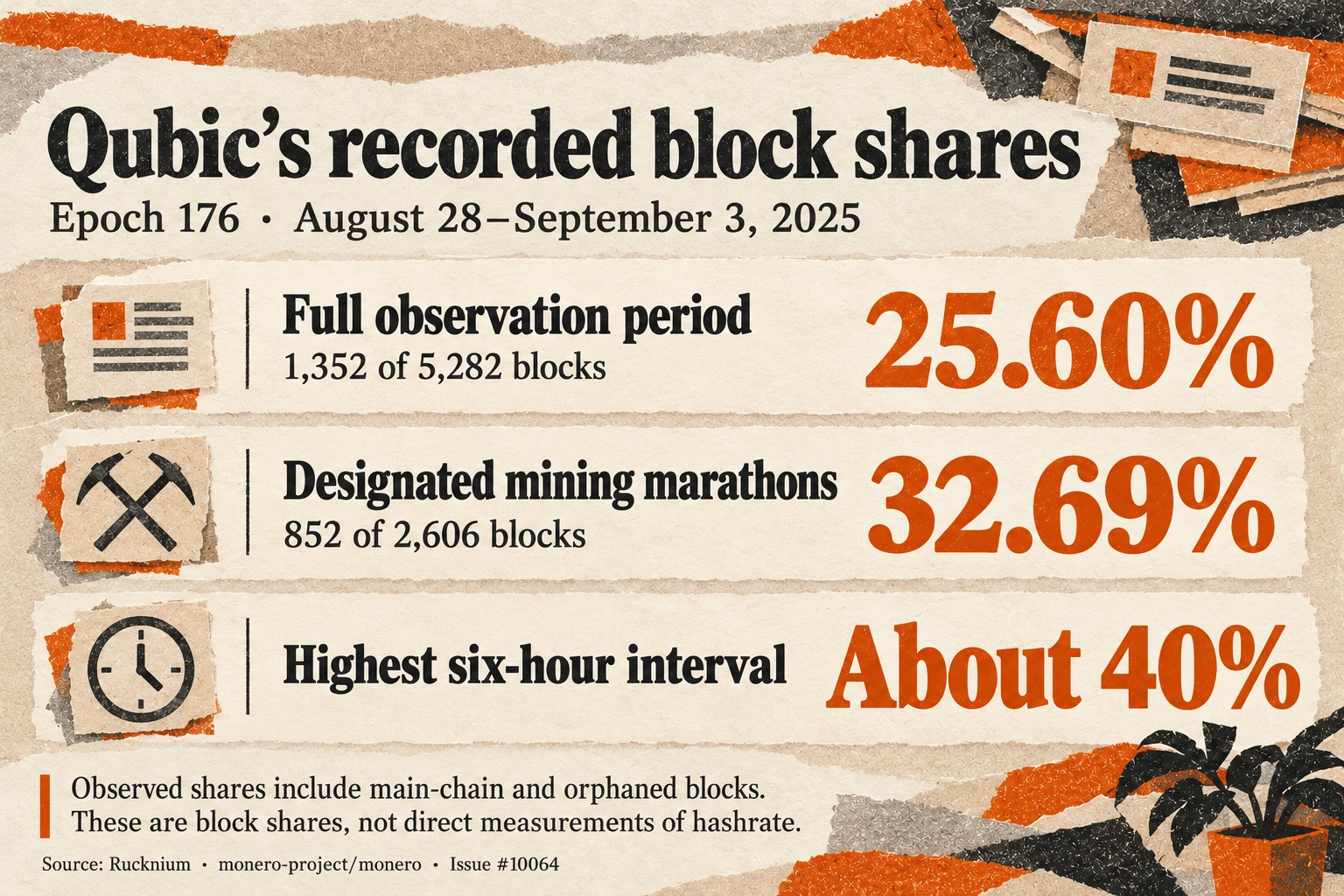
These are observed block shares, not direct processor measurements. Orphan coverage may be incomplete. The analysis takes the block claims of other pools at face value.
A published method and block counts give readers something to check. A triumphant percentage in a promotional post does not. The pool did not show a majority share across that period. These observations cannot prove Qubic never crossed 50% for any brief interval outside that window.
Why a reorganization does not prove 51%
A blockchain reorganization, or reorg, replaces an accepted branch of blocks with a competing one. A minority miner can occasionally achieve a deep reorganization. Rucknium explicitly warned about this before the September incident. The danger exists below the headline threshold. Monero's technical discussion.
“We displaced blocks” and “we continuously controlled most mining power” are different claims. Evidence for the first cannot simply be recycled as proof of the second.
A miner below 51% can still invalidate payments through a deep reorganization. Dismissing that risk would repeat the same mistake as Qubic's publicity: reducing a complicated attack to one convenient number.
The September 2025 18-block reorganization

On September 14, 2025, Qubic produced a competing branch of 20 blocks, displacing 18 previously accepted blocks at heights 3,499,659 through 3,499,676. DataHoarder's published reconstruction includes timestamps, block references, and corroborating Tari and P2Pool observations. September 14 event record.
The record also explains why some payments became invalid. A deep reorg can change the numbered references a transaction uses to identify past outputs, including its decoys. A payment that appeared confirmed could become invalid. That matters for merchants, individuals, and services relying on confirmations, including atomic swaps. It does not mean the attacker obtained anyone's wallet keys.
The project's September 17 recap acknowledged the 18-block reorganization and reported 118 invalidated transactions. It still called the attack safe because centralized exchanges had raised their confirmation limits. It then offered this as evidence of its good intentions. Epoch 178 mining recap.
That defense is embarrassingly narrow. Exchanges are not everyone using Monero. A merchant or individual receiving a payment does not become irrelevant because a trading platform adjusted its settings. Causing disruption and then congratulating yourself for restraint is a poor substitute for responsible research.
What independent research found about Qubic's rewards
Suhyeon Lee and Hyeongyeong Kim examined the campaign using node measurements, pool observations, community records, and disclosed view keys. Their paper appeared at the 2026 Conference on Advances in Financial Technologies. It found no sustained majority control. Published research.
The reward comparison was unflattering: across the identified attack periods and subsequent gaps, the pool finished 4.0% below the study's target-rate honest-mining baseline. That compares mining rewards against an estimated alternative, not the project's entire business profit.
The paper also reports that between August 1 and October 17, 2025, XMR ended 1.0% below its starting price, while QUBIC ended 43.2% lower. Those figures do not establish what caused either price change. That was a bruising period for anyone holding the QUBIC token throughout.
What the takeover claim established
The campaign caused disruption, and its promoters oversold what that proved. The observed campaign did not establish sustained control, and its mining strategy underperformed the research baseline.
For Monero, the episode exposed a security problem worth taking seriously. For Qubic, it leaves an uncomfortable question: why sell the public a takeover story when the available measurements support a much narrower claim?
Qubic wanted credit for the spectacle. It deserves scrutiny for the damage and the sales pitch that accompanied it.