Regulation / Exchanges / Privacy
What FinCEN's MEXC Order Actually Prohibits
FinCEN's MEXC order targets transfers by covered U.S. financial institutions. Read its scope, publication status, crypto-transfer limits and MEXC's response.

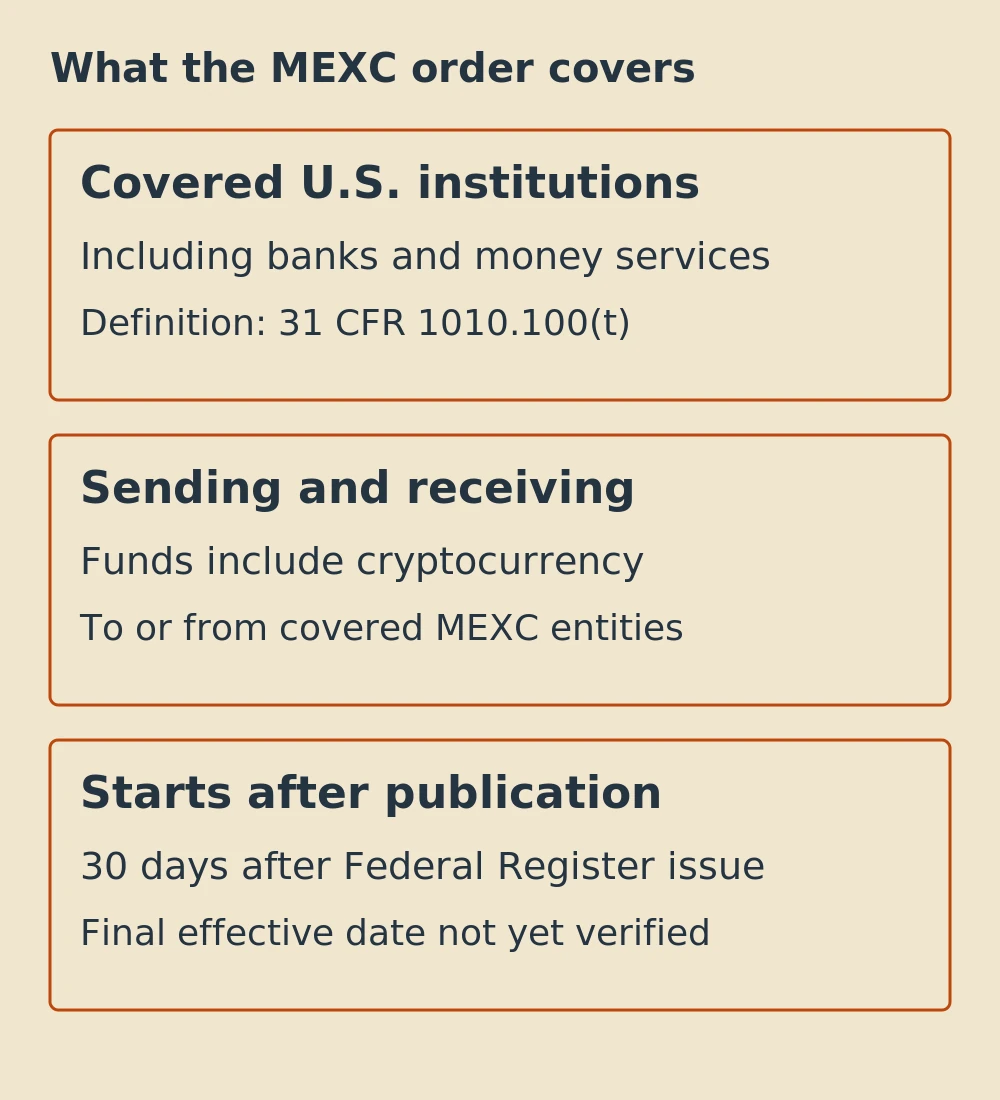
The FinCEN MEXC order, announced on November 6, prohibits covered U.S. financial institutions from sending or receiving funds to or from MEXC Global once it takes effect. The definition includes cryptocurrency. The restriction uses a specific anti-money-laundering power. It does not establish that every MEXC customer committed a crime.
The start date depends on publication. At our 04:51 UTC research cutoff on November 10, 2026, Federal Register document 2026-22962 remained an unpublished public-inspection filing scheduled for November 10 publication. Its text says the order takes effect 30 days after publication. The final publication and effective dates were not yet confirmed. The scope below describes the announced order, not a prohibition already in force.
The legal measure behind the headline
Treasury announced the action on November 6. FinCEN invokes section 9714(a) of the Combating Russian Money Laundering Act, as amended, and finds MEXC to be a foreign financial institution of primary money-laundering concern in connection with Russian illicit finance.
The order's operative section defines the entities and transfers covered by the prohibition. It includes MEXC's foreign branches, subsidiaries and offices, along with successor entities. That prevents the description from depending solely on one exchange domain or corporate name. The definition expressly excludes MEXC branches, subsidiaries and offices located in the United States for this order's purposes.
Treasury says MEXC facilitated at least $16 billion in illicit transactions involving sanctions evasion and cybercrime. The longer order reports $16.7 billion between May 2021 and May 2026. These are the government's findings, based on public and non-public information. They are not a criminal conviction or an independent audit performed for this article.
Which institutions and transfers are covered
The order incorporates the definition of a financial institution in 31 CFR 1010.100(t). It reaches covered institutions in the United States, including banks, securities brokers or dealers, money services businesses and other listed categories. The scope extends beyond bank wires.
The order defines a transmittal as sending or receiving funds, including convertible virtual currency. It explicitly uses that definition instead of the usual definition in section 1010.100(ddd). A covered exchange cannot assume a cryptocurrency deposit falls outside the restriction simply because no bank wire is involved.
A covered U.S. institution processing an outbound customer transfer to MEXC would need to apply the prohibition when effective. An inbound cryptocurrency transfer raises a different operational problem: an institution may not be able to prevent a blockchain address from receiving funds in the first place.
Receiving a transfer is not always preventable
FinCEN acknowledges that technical limitation in its discussion of cryptocurrency rejection. It discusses discretion based on the facts of a transfer, including cases where funds passed through an unhosted wallet for an extended period or an institution's risk procedures would prevent returning them to MEXC.
That discussion does not instruct institutions to return every deposit automatically. Institutions still have to assess the order, their other legal duties and the circumstances. Sending funds through an intermediate wallet is not described as an exemption from the measure.
Nor does this explain how private Monero transfers could be traced. The order regulates institutional conduct. It does not demonstrate a defect in Monero's cryptography or establish that a customer's onward private XMR transactions have been reconstructed. Our remote-node guide explains why a node connection does not give the operator custody of your funds.
An administrative order is not an OFAC asset freeze
FinCEN's action uses a transfer prohibition. An OFAC blocking measure uses a separate legal mechanism. Section VI.E of the order preserves other obligations, including suspicious-activity reporting and applicable OFAC sanctions. An institution may have duties under both regimes because this order preserves its sanctions obligations.
The order itself is not a judgment finding every customer guilty, a seizure of all exchange assets or proof that privacy-focused cryptocurrencies are unlawful. It warns of civil or criminal penalties for willful violations. Distinguishing the current administrative finding from a future enforcement case does not make the prohibition optional.
What MEXC has said
In its November 7 response, MEXC said it was assessing the order with legal and compliance teams. It said operations were normal and user assets remained secure, and announced an independent review of anti-money-laundering and sanctions controls.
Those statements describe the company's position. They do not independently verify solvency, the outcome of the announced review or uninterrupted access to every payment route. We found no later official response changing those assurances during this review.
Publication and the effective date are still pending
November 6 is the announcement date. November 10 is the scheduled Federal Register publication date shown in the public-inspection PDF. The effective date is a separate date.
The public-inspection document still has an effective-date placeholder, and a scheduled publication date is not confirmation of publication. The final official edition will determine the legal start date.
Customers should read notices from the institutions they use, while institutional compliance teams should work from the final order and its definitions. We did not test withdrawals, review customer accounts or trace transactions.