Monero / Mining / Economics
Monero Tail Emission Explained: Why XMR Has No Supply Cap
Monero creates about 157,680 XMR a year at its target block interval. See how the 0.6 XMR subsidy, fees, penalties and declining supply inflation work.
Monero keeps creating new coins to help pay miners. Under its current rules, the base mining subsidy is 0.6 XMR per block, before any applicable block weight penalty. The target interval is two minutes. That ongoing subsidy is called tail emission.
Monero has no supply cap. The amount added each year is roughly constant, so it becomes a smaller percentage of the total as the supply grows.
What tail emission means
Emission means the creation of new coins. The tail is the continuing part of Monero's issuance schedule after its initial, declining subsidies. Unlike transaction fees, the subsidy creates XMR that did not exist before.
The Monero v0.18.5.4 consensus constants set a minimum subsidy of 0.3 XMR per target minute and a 120-second block target. The reward calculation combines those into 0.6 XMR per block before penalties. It does not create a separate payment every minute.
Transaction fees add to the miner's revenue. They transfer existing coins rather than create more supply. A block with an unpenalized 0.6 XMR subsidy and 0.01 XMR in fees can pay its miner 0.61 XMR, but only 0.6 XMR is new issuance. The fee amount in this example is hypothetical. The distinction appears in the code that validates miner payments.
When tail emission began
Monero entered tail emission on June 9, 2022, at block 2,641,623. The official FAQ records the block's time as 00:29 UTC. A contemporaneous Monero Observer report also records the June 9 arrival.
The Moneropedia entry still says the end of May 2022. That wording conflicts with the actual arrival recorded in the FAQ. The 2020 edition of Zero to Monero estimated May 2022 in its section 7.3.5 footnote. Use June 9 for the actual transition date. The reward calculation follows the emission rules, not a calendar deadline.
How much new XMR is created each year?
At the two-minute target interval, there are 30 blocks per hour. Multiplying by 0.6 XMR gives these estimates:
| Period | Approximate new XMR |
|---|---|
| One block | 0.6 |
| One hour | 18 |
| One day | 432 |
| One 365-day year | 157,680 |
The annual calculation is 0.6 × 30 × 24 × 365 = 157,680 XMR. It assumes blocks arrive at the target average and miners claim the full, unpenalized subsidy. Actual daily issuance varies because blocks arrive at irregular intervals and penalties can reduce the subsidy. A leap year also has an extra day.
The two-minute interval is a target for the network as a whole. It does not mean an individual miner receives a payment every two minutes.
Why the percentage inflation rate falls
The annual addition remains roughly constant while the supply used to calculate the percentage gets larger:
Annual supply inflation ≈ new XMR issued during the year ÷ supply at the start of the year × 100.
Using 157,680 XMR as the annual addition gives these examples:
| Hypothetical starting supply | Annual new XMR | Annual supply inflation |
|---|---|---|
| 20 million XMR | 157,680 | 0.7884% |
| 25 million XMR | 157,680 | 0.6307% |
| 30 million XMR | 157,680 | 0.5256% |
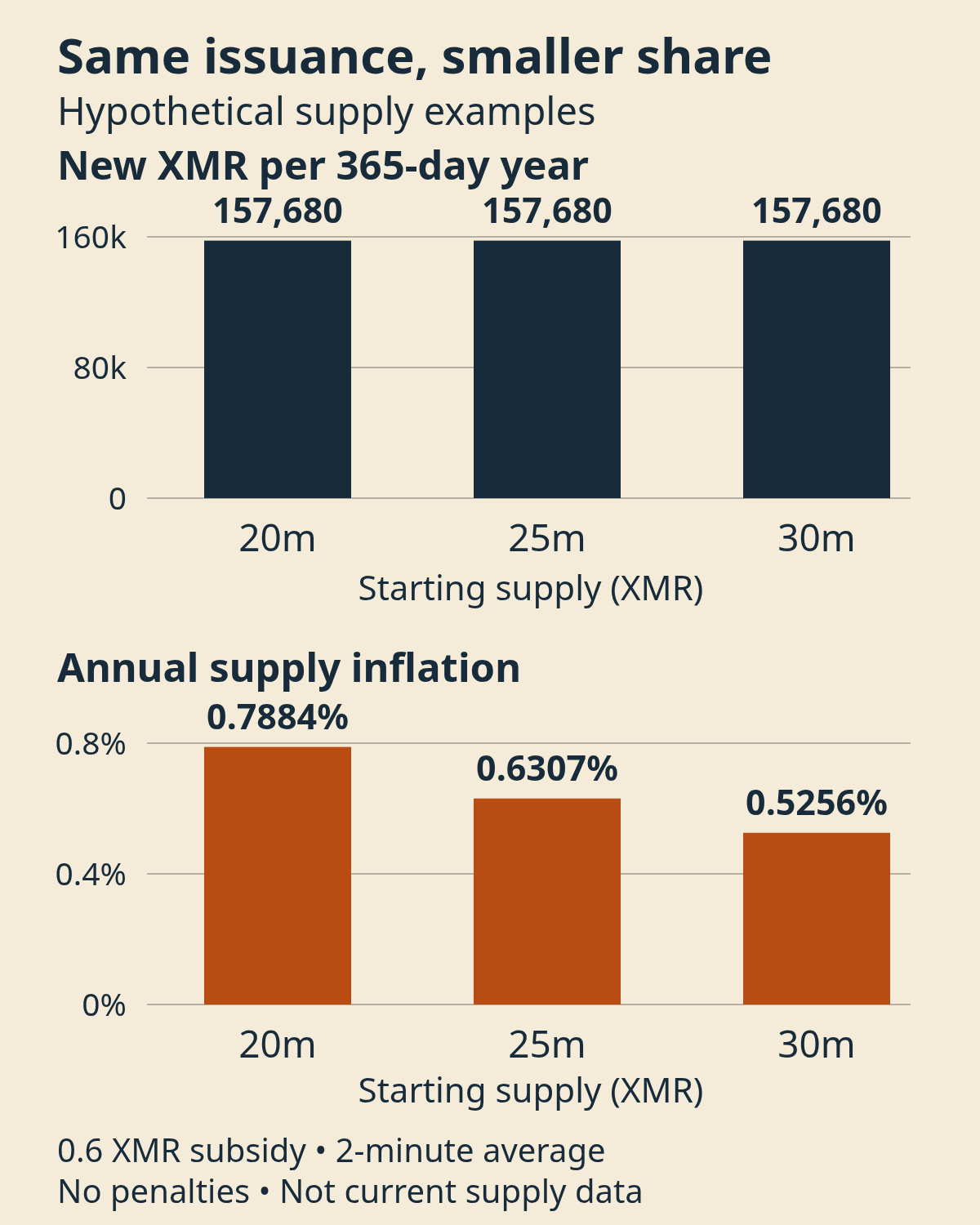
These are illustrative starting supplies, not current supply measurements or dated forecasts. Percentages are rounded to four decimal places. With continuing issuance, the percentage approaches zero but does not reach it.
Here, inflation means growth in the number of coins. It does not predict XMR's exchange rate or what you can buy with it.
Why keep paying miners with new coins?
Miners spend money on equipment and electricity to perform proof of work. The subsidy gives them revenue alongside transaction fees. Monero's stated reason for tail emission is to preserve a mining incentive and support its dynamic block size and fee market, as described in the Moneropedia entry above.
Without a subsidy, miner revenue would depend entirely on fees. Tail emission reduces that dependence, although a fixed XMR reward cannot guarantee a security budget in dollars. Mining economics still depend on XMR's price, operating costs, competition and fees. The P2Pool guide explains how to mine through a decentralized pool and why personal payouts vary.
How block weight penalties affect the subsidy
Block weight is the protocol's measure of a block's size, including adjustments for some transaction data. When a block exceeds the applicable full-reward threshold, the reward calculation reduces its subsidy. The threshold follows the network's block weight rules rather than a fixed number of transactions.
A miner considering a larger block must weigh additional fee revenue against the subsidy lost to that penalty. Keeping a subsidy preserves that cost. The reward formula pays 96% of the base subsidy for a block at 1.2 times the effective full-reward threshold: 0.576 XMR instead of 0.6 XMR, before adding fees. This illustrates the formula, not a measured average penalty.
Zero to Monero, second edition, sections 7.3.3 and 7.3.5 explains the penalty and tail-emission rationale. The release code linked above is the reference for the calculation used here. Nodes enforce these limits when checking blocks. Running monerod performs that validation, but it does not earn rewards unless mining is also enabled. See the monerod command reference for the separate mining controls.
What tail emission means for holders
If you hold 10 XMR, issuance does not subtract anything from those 10 XMR.
Your share of the total supply shrinks as miners create coins, assuming you add none to your holdings. That dilution is the cost holders bear in exchange for ongoing issuance to miners. It persists even though the percentage becomes smaller over time. A smaller share of supply does not by itself establish a loss of purchasing power, which also depends on demand.
The unknown quantity of lost coins complicates estimates of spendable supply. The protocol neither measures those losses nor adjusts issuance to replace them. Without a reliable loss estimate, claims that Monero must be deflationary are unsupported.
Does tail emission have an end date?
Under the current consensus rules, tail emission has no scheduled end. The rules specify no final mining date or reduction of the base subsidy to zero.