Cake Wallet / Privacy
Cake Wallet's Tor-Only Fiat API Can Leak Onion Hostnames
Cake Wallet's Tor-only fiat API can send onion names to system DNS. Review the affected code, Android test evidence, external Tor limits and patch status.
Cake Wallet / Privacy / Security
Cake Wallet's draft Ask Cake assistant runs models on an iPhone. We review its wallet access, payment checks, debug logs and Tor model downloads.

Cake Wallet is testing Ask Cake, an iPhone assistant that can explain activity in the open wallet and fill in a payment for review. Asking a wallet how much you spent last month involves financial records. Running the assistant on the phone lets the app process those records without sending them to a cloud chatbot. It also puts generated text and payment suggestions inside an app that can move money.
Pull request #3901 is an open draft with five commits and an internal TestFlight deployment as of November 24, 2026 UTC. This review covers commit 8a32e4f. The latest stable release, Cake Wallet v6.5.4, lacks the Ask Cake source files.
A fine-tuned SmolLM2-135M model classifies requests and extracts details such as an amount or contact name. It runs through Apple's Core ML, loading on the CPU first and preparing a Neural Engine copy in the background. Dart code selects from a fixed set of capabilities and decides whether to answer, ask for clarification or offer a button. Some requests, such as opening the scanner, have direct rules. Native bridge · Request handling
Apple's on-device Foundation Models session writes help replies and optional summaries. It can also classify requests or extract fields on paths without the trained router. Dart retains control of wallet actions, and the Swift session does not register tools. The draft describes iOS 27 testing. The native bridge checks for iOS 26 or later and an available Apple Intelligence model. The menu is iOS-only, and the lower code gate leaves iOS 26 device behavior unverified. Apple Foundation Models · Menu gate
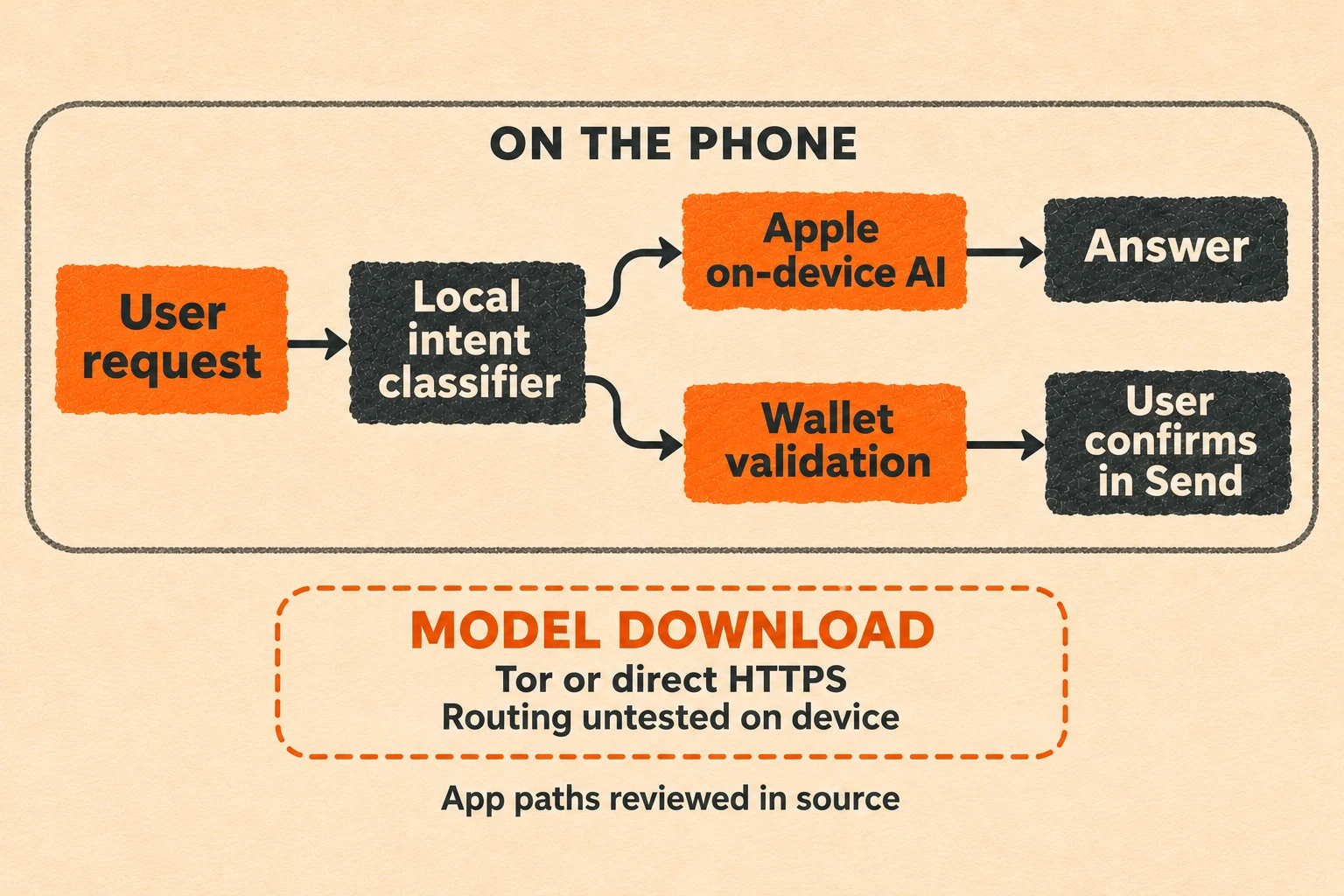
The diagram shows the main paths visible in the draft code. When Cake starts its internal Tor client, the download uses Tor for both the onion service and the HTTPS fallback.
The reviewed inference paths call on-device APIs. Voice input also checks that Apple's recognizer supports local processing and sets requiresOnDeviceRecognition. Unsupported devices get an error. After a short pause, dictated text can go straight into chat. Stopping dictation manually leaves it in the input box for correction. This is a source finding. We did not capture device traffic. Native bridge · Apple Speech documentation
Balances, fees, transaction notes and swap records can enter an on-device summary prompt. The trained router masks recognized addresses and invoices in user turns, while wallet replies can display receive and contact addresses for users to copy. The input filter looks for a run of at least 11 words from bundled lists or recognizable key patterns, including 64 hexadecimal characters and WIF keys and listed extended private-key prefixes. It checks patterns without verifying seed checksums. Ordinary text can match, and coverage depends on the word list and input format. Wallet data · Input filter
The filter rejects matching turns before ordinary inference, but the chat already stores the original text in memory. A debug build prints the raw question and reply even after rejection. An opt-in file log skips flagged turns and masks recognized addresses in the message, but still stores timestamps, other text and interaction details. The code exposes a manual share action. We did not test whether backups, crash reports or OS diagnostics include chat data. Chat and debug logging · File log
The chat offers a button that opens Cake's regular Send form with payment details filled in. It takes a recognizable address from the user's message when possible, otherwise tries to resolve a contact. It checks the contact's currency and available balance. A string that resembles an address can get as far as the handoff. Send checks the address and amount. It calls the app's authentication service before presenting a separate transaction confirmation. Authentication behavior depends on wallet configuration. Our coverage of Cake Wallet's iOS PIN fix looks at a separate authentication issue. Send preparation · Send screen
An amount must match a number the user supplied for that action. When two or more numbers qualify, the router can choose among them. Fiat conversion uses the price stored for the active wallet and its configured display currency, even though the request parser recognizes dollar wording. That deserves tests with a different fiat setting. A valid address may still belong to the wrong person, and an amount can be valid in the wrong unit. The open account supplies transactions and totals. The assistant can offer to switch a Monero or Wownero account after a tap. The PR reports that the Monero switch has yet to run on a device. Amount handling · Account switch
Prompt injection happens when a model treats text inside a record as an instruction. Transaction notes are a concrete input here. The wallet appends them to transaction rows and passes those rows into the summary prompt. The model also reads bundled help excerpts. Dart formats contact listings directly, although contact names still influence recipient selection. The reviewed help lookup reads a bundled index. Opening linked documentation or support is a separate user action. Wallet records · Summary and help prompts
A generated summary could mislead someone about a payment. The code drops some unsupported figures and causal language, but matching figures alone cannot establish the meaning of a sentence. The chat displays the summary as text. A separate Dart path handles wallet actions. A misleading answer or a mistaken prefill can still influence what someone approves. This review did not reproduce an injection or observe a transaction. Action handling
The router package is about 135 MB. The app downloads it after initial consent and stores it in Application Support. A newer package can download without another prompt. The downloader checks each of three files against a SHA-256 digest compiled into the app. A compromised host alone cannot serve different bytes that pass those checks. A compromised app update could change the expected hashes. The ordinary lookup checks a completion marker on later opens without rehashing the files, and a developer copy takes precedence in debug builds or builds without a download source. Model store
We fetched the three public HTTPS files and matched their SHA-256 digests against the app's pins. The files total 135,428,138 bytes, 449 more than the progress counter expects. The onion manifest also matched through a separate Tor client. These checks cover the published files and the reachable endpoints. They do not exercise routing inside Cake Wallet.
When Cake's internal Tor is running, the downloader tries an onion host first. Connection or HTTP failure can send it to the regular HTTPS host through the same SOCKS-backed client. With internal Tor stopped, the default route uses HTTPS directly. The requested paths contain package and version identifiers. A direct download exposes the connecting IP to the service. Tor changes who can observe the connection, while the service still sees the file requests. Device testing would need to check DNS, redirects and failures. Our earlier Cake Wallet DNS coverage concerns the fiat price client's separate routing logic. Proxy client
We counted 21 unit tests for guards, text parsing and tokenization. GitHub shows a passing unit job. The author reports 184 passes from 185 scripted simulator conversations. The checked-in grader looks for expected fixture calls, arguments and reply text. It never reaches real payment authorization. The identity of the failed case was unavailable. The separate 17-pass result came from a report-only Android no-funds lane. The Android menu omits Ask Cake, and the detailed CI artifact required authentication. Unit tests · Fixture grader · Android QA run
The draft has no submitted reviews. The hidden self-test still opens from the chat title, even with the recording flag that hides debug buttons. The draft also lacks localized strings and a device test for Monero account switching. An independent audit could pair packet captures with checks for rejected input and retained chat data. Synthetic wallets with different accounts and currency settings would allow testing the payment handoff and authorization.
Keeping inference on the phone removes the need for a cloud chatbot in the reviewed paths. The release decision still depends on which wallet records the models read, what it retains after a question, and how faithfully Send presents the payment the user meant to make.