Monero / Payments
The Monero Circular Economy: Why Earning and Spending Matter
A Monero circular economy connects people who earn, spend and accept XMR. Learn why those connections matter for privacy and everyday payments.
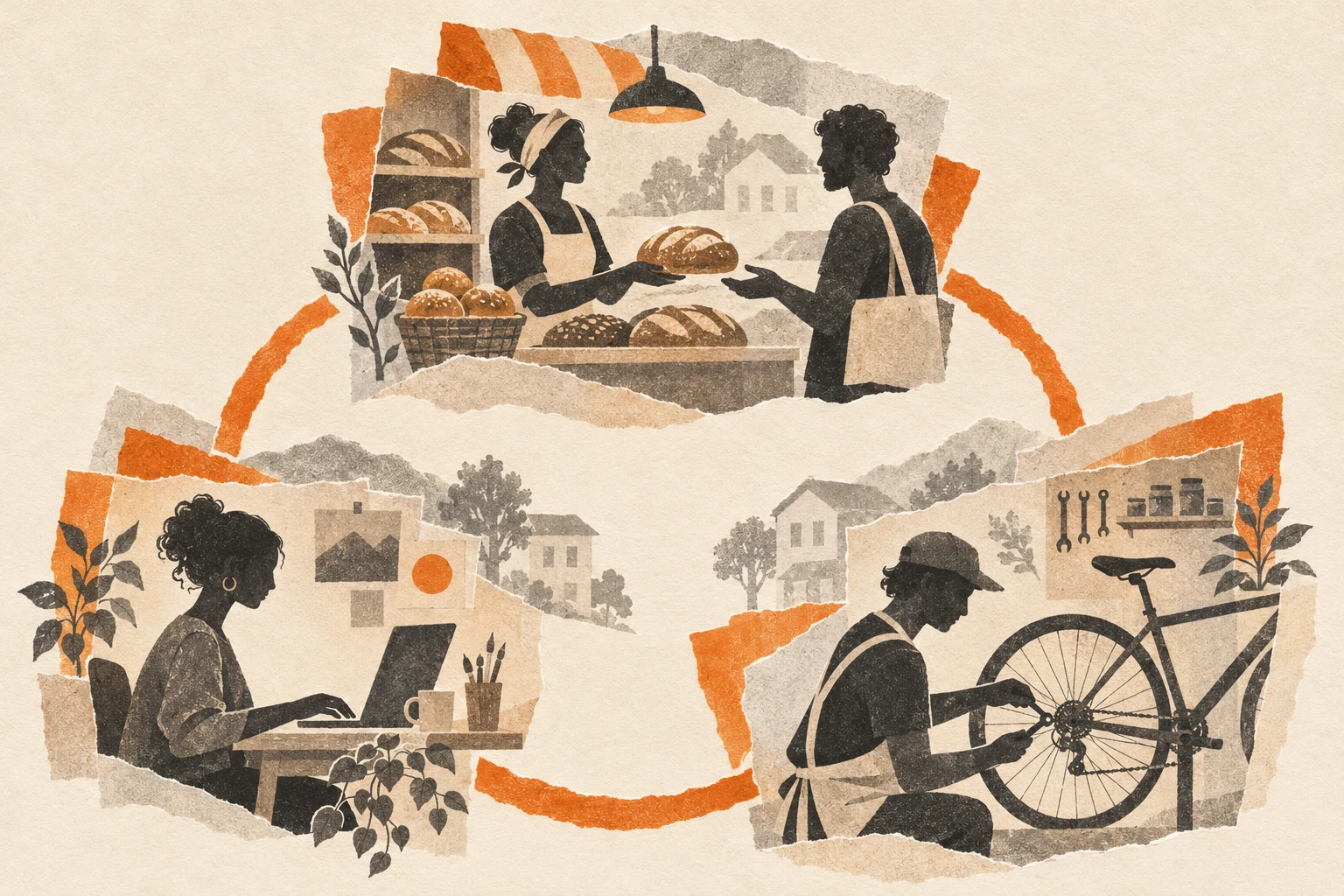
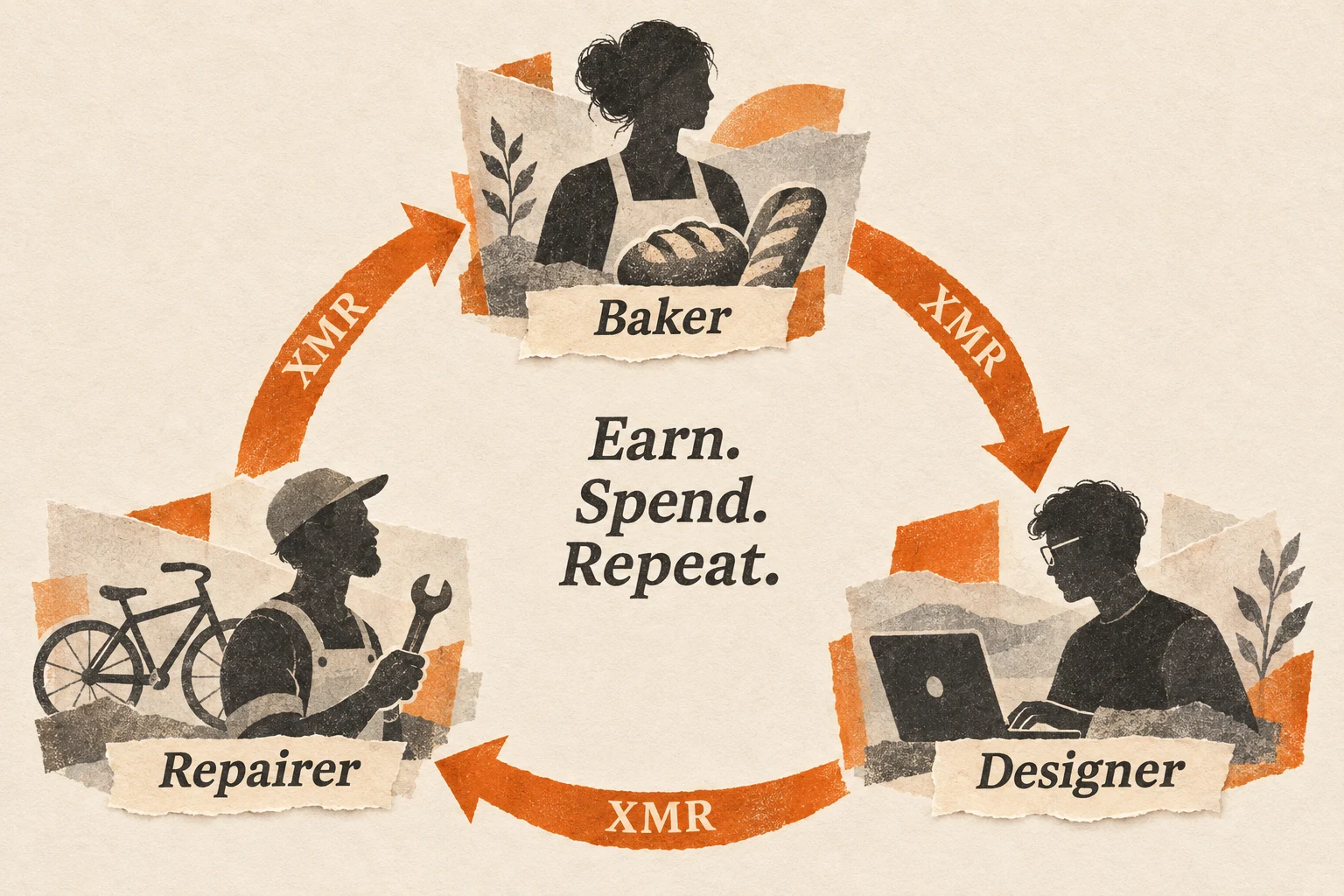
A customer pays a baker in Monero. The baker uses some of that XMR to pay a designer. The designer pays a bicycle repairer, who buys bread from the baker.
This imagined neighborhood illustrates a Monero circular economy: people earning XMR and spending it on goods and services, with recipients able to use it again. Money moves between people doing useful work without every payment requiring a conversion back into national currency.
That matters because the usefulness of private money depends partly on where you can use it. A wallet can give you control over your funds. A network of willing customers, workers and businesses gives you somewhere to spend them.
What makes an economy circular?
In this context, circular describes the movement of money through repeated trade. It is different from the environmental use of the term, which concerns resources, reuse and waste.
Buying XMR, paying a shop and having the shop immediately convert the entire payment into dollars still enables a purchase. But the next step toward circularity is giving that shop something useful to buy with its XMR.
The loop does not need to be perfectly closed. A business might spend part of its Monero revenue with a supplier and convert the rest to cover other bills. A freelancer might accept XMR for one project while receiving other income in their usual currency.
Nor does the money need to return to its original sender. The important connection is between one person's income and another person's sale. A local cafe and a remote software developer can both participate.
Privacy becomes useful in ordinary life
Monero is designed to conceal transaction senders, recipients and amounts from public blockchain observers. Its privacy protections apply by default. The Monero Project's introduction explains those properties.
For commerce, the purpose is straightforward. Paying an invoice should not publish your wider financial activity for strangers to inspect. A business should be able to receive payments without turning its blockchain address into a public revenue dashboard.
A circular economy gives people more opportunities to use those protections. Someone who earns XMR and can spend it directly has fewer reasons to move that money through a conversion service between purchases. Whether that improves their privacy also depends on the services and information involved.
Monero cannot hide information you give a seller. A delivery address, account login or conversation can still identify you. The project's privacy FAQ explicitly cautions that Monero is not magic and does not provide absolute anonymity.
More ways to trade mean less dependence on exchanges
An exchange provides a route between currencies. It does not provide the bread, repairs or design work that make those currencies useful.
When every purchase begins with buying XMR and ends with selling it, exchange access remains central to the experience. If customers can earn Monero and merchants can spend their receipts, some transactions can happen without that intermediate step.
This is a practical form of resilience. A trading venue becoming unavailable need not prevent two people who already hold and accept XMR from doing business. It can still affect access, liquidity and pricing, especially for people who need to convert.
The strongest version of this argument is modest: more direct trading relationships give people more options. They do not make the surrounding financial system irrelevant or guarantee a stable purchasing power.
Merchants need somewhere to spend their receipts
An "XMR accepted here" sign creates an opportunity. Repeat customers and payable expenses make that opportunity more useful.
Consider the baker again. Accepting Monero becomes easier to sustain when the designer who handles the shop's menus also accepts it. The designer has a reason to seek out other businesses that take XMR.
Asking a merchant what they need to buy can be as useful as asking whether they accept Monero. Hosting, maintenance, translation, equipment and professional services are possible connections. The actual choice depends on price, quality and whether both sides want the arrangement.
A directory can help people find each other. The Monero Project's merchant page points readers to directories and advises checking businesses before trusting them with money. A listing is a starting point, not proof of reliable service or continuing acceptance.
What still makes everyday use difficult?
Prices and cash flow matter. If a seller prices goods in a national currency, an XMR quote needs a clear exchange rate and validity period. Holding receipts in Monero also means their purchasing power can change before the seller pays an expense. Circular trade does not remove that uncertainty.
Payment handling needs care too. Sellers need a process for invoices, confirmations, refunds and customer support. The official accepting Monero guide describes receiving payments, using subaddresses and watching confirmations. It also explains that newly received funds require at least 10 confirmations before they can be spent. An incoming payment is not immediately reusable cash.
For a broader look at merchant tools and adoption, see our Monero point-of-sale overview.
Then there is the ordinary difficulty of finding a good supplier. Someone may accept XMR but sell nothing you need. A nearby business may offer exactly the right service but have no interest in changing its payment process. Useful trade depends on solving those mismatches, one relationship at a time.
How to help build it
Start with a purchase you already intend to make. Check whether a suitable business accepts Monero, confirm its terms and use it again if the service is good. Buying unwanted things merely to produce transactions does little to make the economy useful.
If you sell goods or services, consider offering XMR as a payment option. State what you sell, how customers can order and how payment works. Before expanding, work through a small payment and make sure you can recognize it in your wallet.
Look for one expense you could pay from those receipts. One dependable supplier may do more for your ability to keep using XMR than a long list of unrelated merchants.
Help the next person learn the routine. Clear invoices, accurate payment instructions and patient support make a second purchase easier. Customers should be choosing a useful product and a workable payment method, not struggling with payment instructions.
Progress is a payment someone can use again
A growing list of merchants is encouraging, but it does not tell us how often customers return or whether businesses spend their receipts. Transaction counts alone cannot establish those relationships either. A payment on a blockchain is not automatically a retail purchase.
More useful questions are practical. Can someone earn XMR for work and buy something they need with it? Does the recipient have useful spending options too? The experience needs to be convenient enough to repeat.
The Monero circular economy grows when the answers improve. Every reliable customer, useful service and willing supplier gives private money another place to work.