Monero
What Is the Levin Signature? A Beginner's Guide to Monero's Network Messages
Learn what Monero's eight-byte Levin signature does, where it appears in network messages, and what it can reveal about unencrypted traffic.

The Levin signature is a fixed eight-byte marker at the beginning of a Levin network header. Monero nodes use this protocol to exchange messages. The marker helps receiving software recognize the expected format before interpreting the rest of the data. It provides no proof of who sent the message. Monero's protocol documentation describes its role.
Why Monero messages need a header
A Monero node is a computer running software that participates in the network. Nodes relay transactions and exchange blocks. To communicate, they need an agreed format that tells each computer how to read incoming data.
Think of a parcel with a label on the outside. The label helps someone handle the parcel before opening it. A network header serves a similar purpose for software. It contains information about the message, while the body carries the data being exchanged.
The signature sits at the front of that header. If another application connects to a node's networking port by mistake, its data may start with an unexpected sequence. That mismatch helps the receiving software recognize that it is not reading the format it expects.
What the eight bytes look like
On the network, the Levin signature appears as this sequence:
01 21 01 01 01 01 01 01
Each pair represents one byte, a unit containing eight bits. The numbers use hexadecimal notation, which writes byte values compactly with digits and the letters A through F. Here, only digits are needed.
In Monero's source code, the constant is written as 0x0101010101012101. It looks reversed because Levin sends this number with its least significant byte first, an ordering called little endian. Both forms describe the same value.
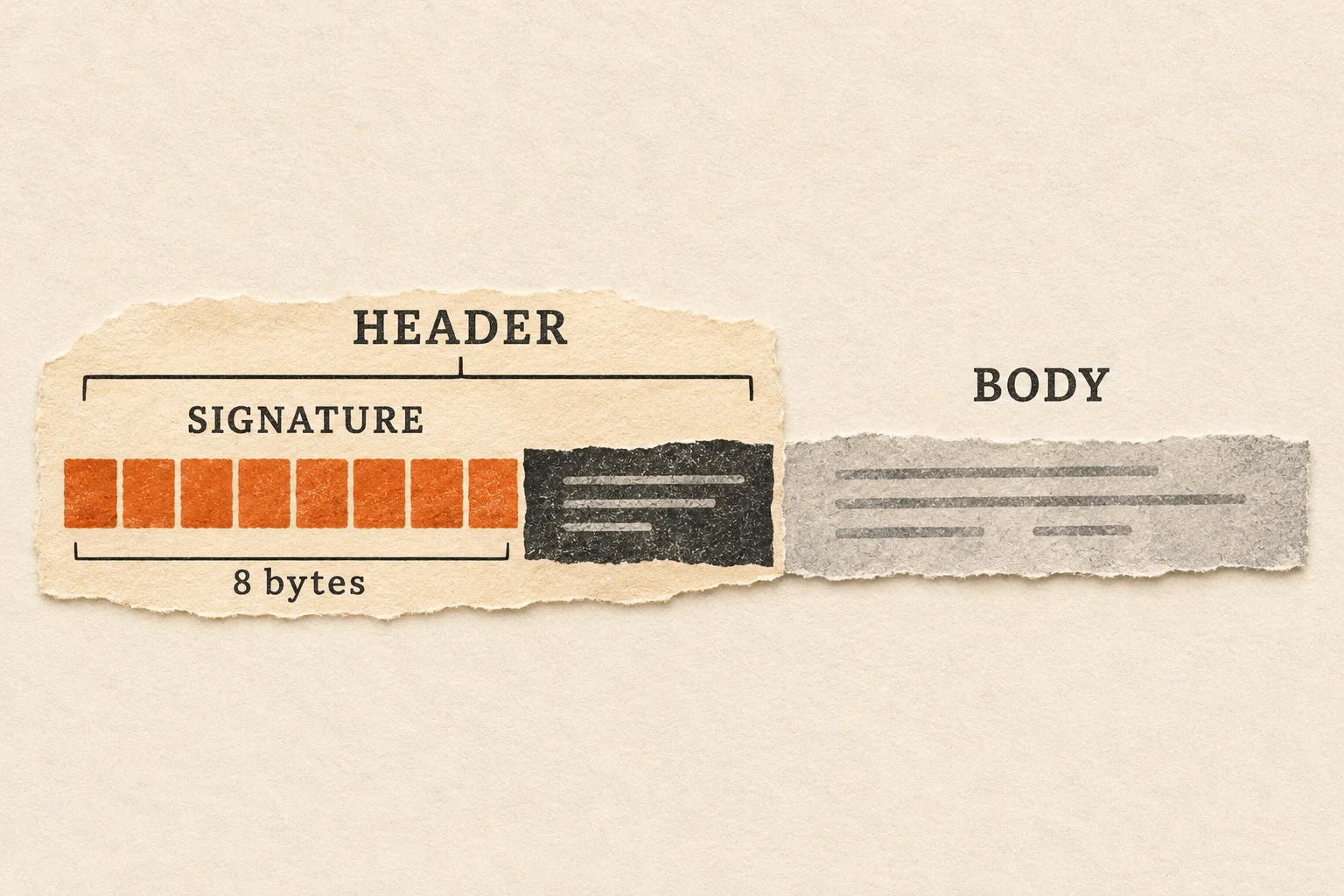
The illustration shows placement, not relative sizes. The full header occupies 33 bytes. Beyond the signature, it records the body length, command, response information, flags, and protocol version. Cuprate's Monero Book documents these fields. The command tells software what kind of message the body contains.
Why it does not authenticate a sender
The word “signature” has another meaning in cryptocurrency. A cryptographic signature lets software verify signed information and detect changes to it. Creating one involves a private key.
The Levin marker is public and fixed. Anyone can reproduce those eight bytes without possessing a private key. Finding the expected sequence therefore cannot establish that a peer is trustworthy or that a transaction is valid. Those questions require other checks.
For a practical example of cryptographic verification, see our guide to verifying a PGP signature. A download signature binds signed data to a signing key. Copying a protocol marker offers none of that protection.
What the Levin signature reveals about traffic
A predictable opening pattern can also help a network observer recognize traffic. Monero's documentation notes that deep packet inspection can identify Monero traffic using the signature when the connection is unencrypted. This means examining the bytes moving across a connection.
Detection of a protocol is different from tracing a payment. These eight bytes contain no sender address, recipient address, or payment amount. Recognizing them alone does not reveal who paid whom. It can still expose the type of traffic a connection carries, which matters where networks monitor or filter cryptocurrency use.
When reading a packet capture or a technical explanation, treat the Levin signature as a format marker. Questions about encryption, peer identity, and transaction privacy each need their own evidence.